
If you’ve ever stood in a hardware store staring at a tape measure or tried to picture a “meter” without a ruler in hand, you’re not alone. The meter is the backbone of the metric system, yet most people raised on feet and inches still find it hard to picture. This guide breaks down exactly how long a meter is, what it looks like in real life, and how it converts to every unit you’re likely to need — from centimeters to megameters.
What is a Meter?
A meter (spelled “metre” outside the US) is the base unit of length in the International System of Units (SI). It’s the standard every other metric length unit — centimeters, millimeters, kilometers — is built from.
Officially, a meter is defined as the distance light travels in a vacuum in 1/299,792,458 of a second. That sounds technical, but in practice, a meter is simply a fixed length equal to:
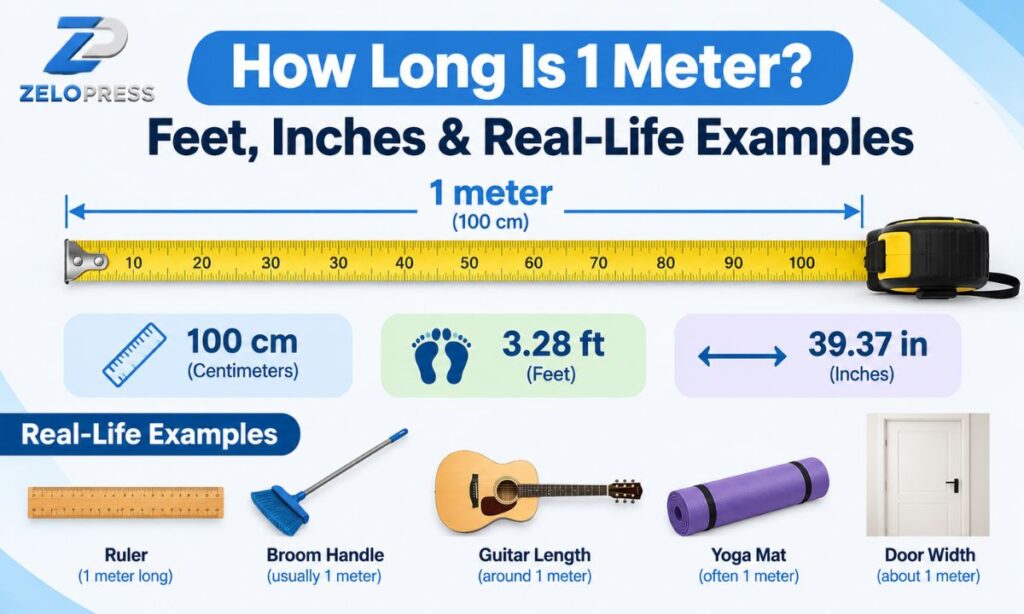
- 100 centimeters
- 1,000 millimeters
- 3.28 feet
- 39.37 inches
It’s used worldwide for everything from measuring a room to marking out a running track, and it’s the unit most countries — outside the US, Liberia, and Myanmar — use as their everyday measurement of length.
The meter’s definition has actually changed several times throughout history. It was originally based on the distance from the North Pole to the equator, measured along a meridian passing through Paris. Scientists later switched to a physical platinum bar, then to the wavelength of light, before settling on today’s speed-of-light definition, which is far more precise and doesn’t rely on any physical object that could wear down or change over time.
Because it’s the base unit in the metric system, the meter also forms the foundation for area (square meters) and volume (cubic meters), making it one of the most versatile units in science, construction, and everyday measurement.
How long is 1 meter visually?
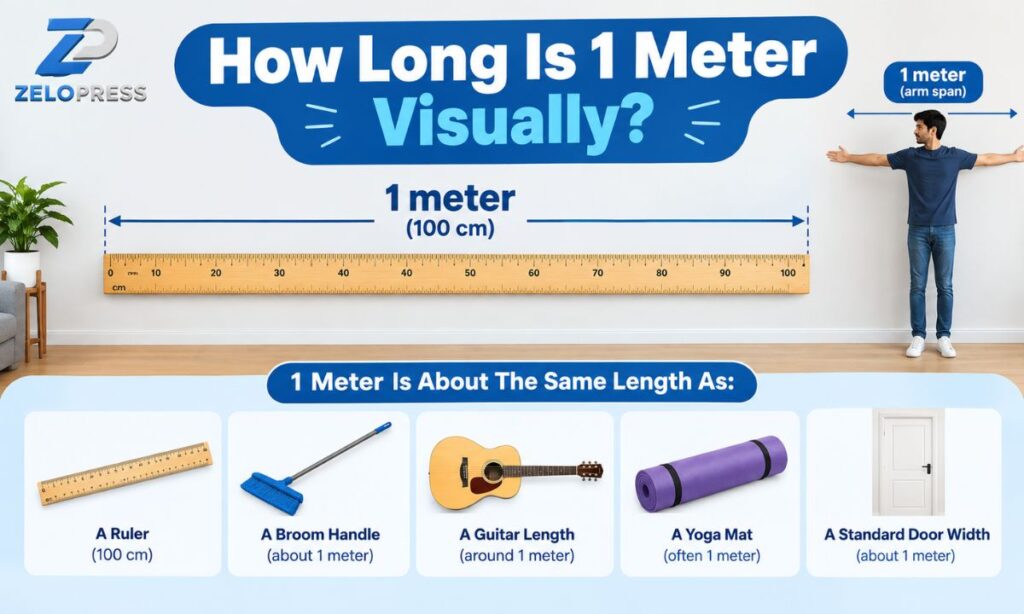
Without a tape measure, a meter is roughly:
- The height of a kitchen countertop
- One long adult stride or “giant step”
- The distance from a doorknob to the floor
- Slightly longer than a yardstick (a yardstick is 3 inches short of a full meter)
Picturing it against something familiar — like a countertop or a stride — makes the abstract number “100 centimeters” much easier to visualize.
Read More Measurement : how long is 1 meter
How long is 1 meter in feet?
One meter equals 3.28084 feet. For everyday use, most people simply round this to 3.28 feet.
Is 1 meter 3 feet?
Not exactly — 1 meter is a little more than 3 feet. It equals 3 feet and roughly 3.37 inches, so if you measure out 3 feet flat, you’ll fall about 3.4 inches short of a true meter.
How long is 1 meter in length?
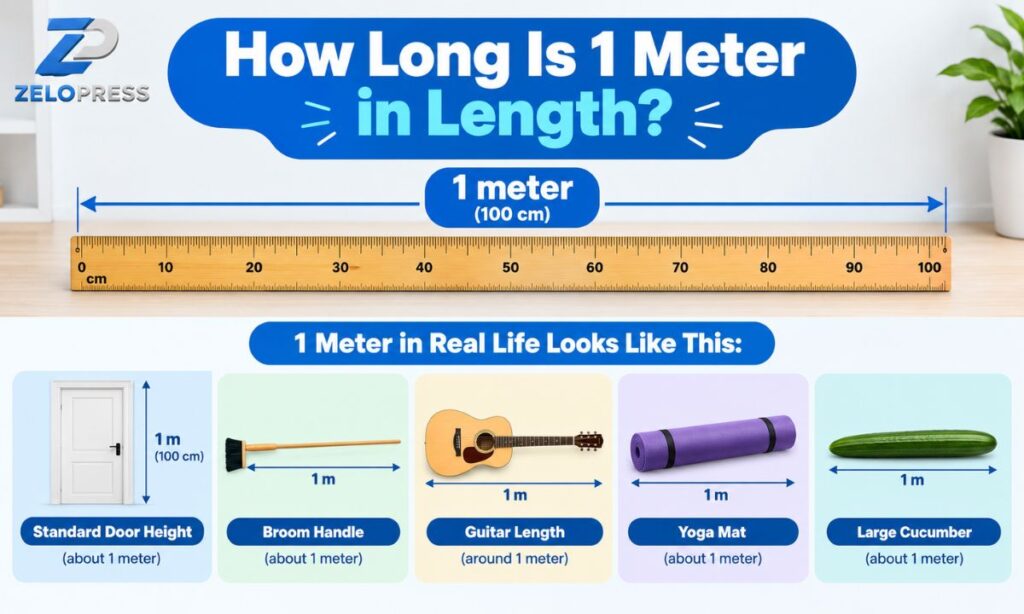
In plain terms, a meter is a medium-sized unit of length — bigger than a foot, smaller than a kilometer — ideal for measuring rooms, furniture, doorways, and human height. It sits comfortably between small measurements (centimeters, inches) and long distances (kilometers, miles).
How long is 1 meter in inches
One meter equals 39.37 inches. This is one of the most commonly searched conversions because inches are still widely used for smaller measurements in the US, such as screen sizes and furniture dimensions.
How long is 1 meter on a ruler
A standard ruler is only 12 inches (30 cm) long, so a single ruler can’t show a full meter — you’d need over 3 rulers laid end to end. This is why meter sticks (or “metre rules”) exist: they’re purpose-built, 100 cm long, and marked in centimeters and millimeters so you can measure a full meter in one go.
How long is meter in feet
To repeat this common variation of the search: 1 meter = 3.28084 feet, or about 3 feet 3⅜ inches when expressed in feet and inches together.
How long is 1 meter in human body
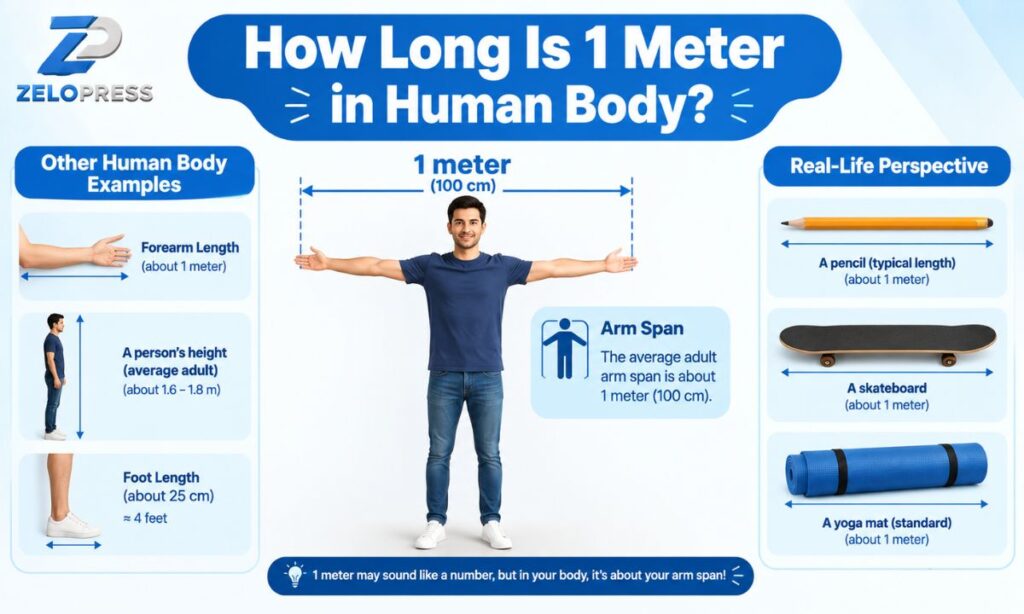
The human body offers some surprisingly reliable built-in meter references:
| Body Reference | Approximate Length |
| Adult’s outstretched arm span (wrist to opposite shoulder) | ~1 meter |
| Waist height of an average adult | ~1 meter |
| Height of an average 5-year-old child | ~1 meter |
| One long walking stride | ~1 meter |
These references won’t be perfectly precise for every body type, but they’re handy for quick, tool-free estimates.
Meter Abbreviations and Symbols
The meter is abbreviated simply as “m” in both the metric system and international scientific notation. You’ll see it written as:
- 1 m = 1 meter
- Compound units like m/s (meters per second) or m² (square meters) also use this same base symbol
Unlike some units, the meter symbol doesn’t take a period or plural “s” in formal scientific writing (1 m, not 1 m. or 1 ms — the latter actually means milliseconds).
How to measure 1 meter by hand?
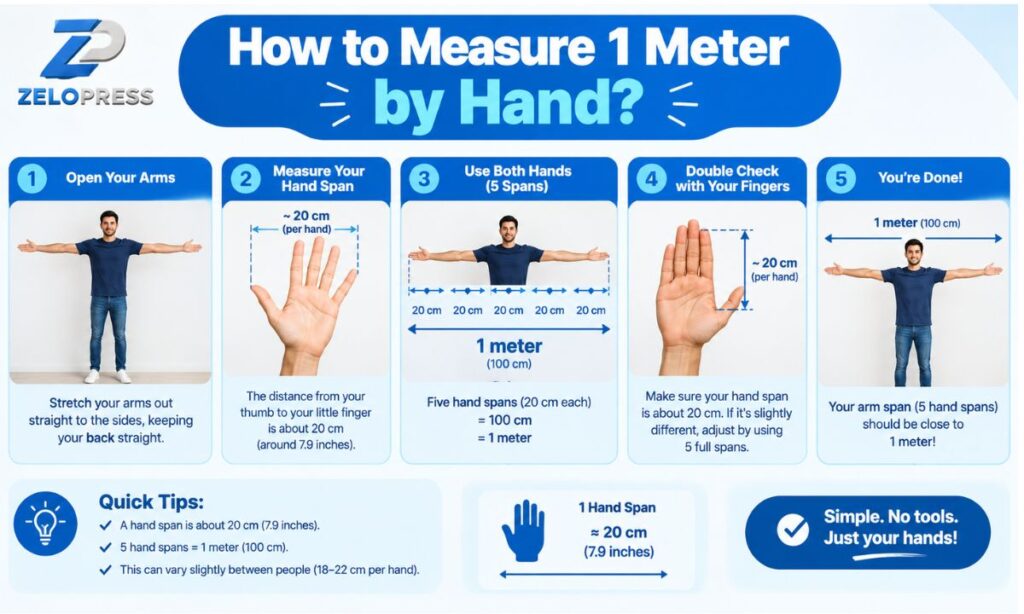
If you don’t have a tape measure, try these simple methods:
- Use your arm span — for many adults, fingertip to opposite shoulder is close to 1 meter.
- Take one big step — an adult’s long stride is roughly 1 meter.
- Stack two standard rulers plus a bit — two 30 cm rulers plus about 40 cm covers it.
- Use a door as a guide — half the height of a standard interior door is very close to 1 meter.
- Use your phone — apps like Google Maps’ “Measure Distance” or AR-based measuring apps can approximate a meter using your camera.
None of these methods are lab-accurate, but they’re good enough for quick, real-world estimates.
What is 1 meter in real life?
A meter shows up constantly without most people noticing:
- The width of a standard doorway is close to 1 meter
- A guitar or baseball bat is about 1 meter long
- A kitchen countertop typically stands about 1 meter off the floor
- Race distances like the 100-meter dash use the meter as their base unit
- Fabric and wrapping paper are frequently sold by the meter in metric countries
- Swimming pools are often measured in meters, with Olympic pools being exactly 50 meters long
What objects are 1 meter long?
Common everyday objects close to 1 meter include:
- A full-size guitar
- A baseball bat
- A yardstick plus a few extra inches
- A large stride or step
- A standard countertop’s height
How long is 1 meter without a ruler?
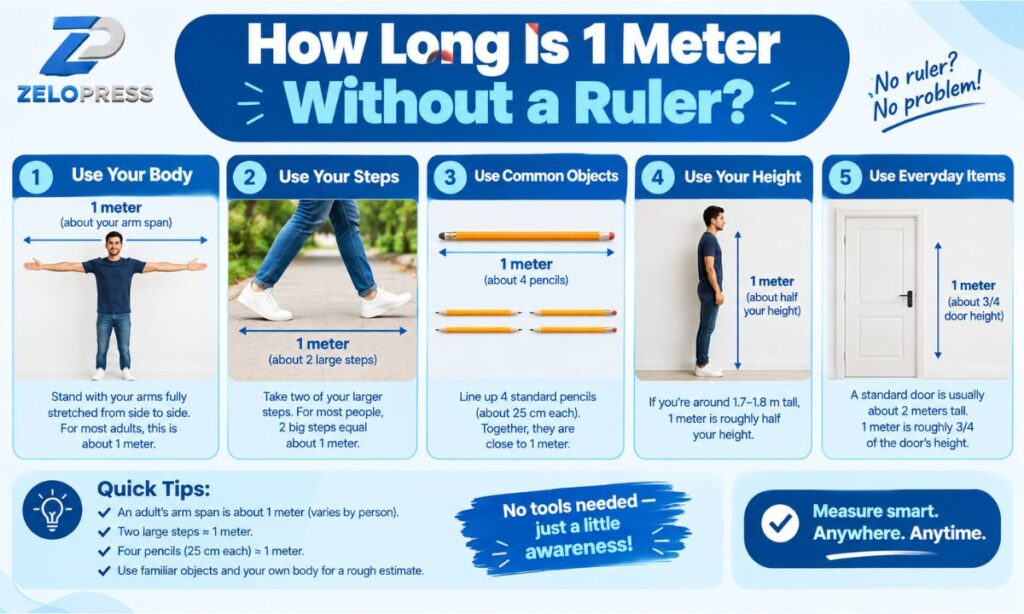
Without any tools, the most reliable trick is combining two references: measure roughly with an arm span or stride, then double-check against a known object like a door or countertop. It won’t be exact, but it’ll be close enough for casual use.
Conversion Of Meters
Meters convert cleanly into other metric and imperial units. Here’s a quick-reference table:
| Unit | Equivalent to 1 Meter |
| Millimeters | 1,000 mm |
| Centimeters | 100 cm |
| Inches | 39.37 in |
| Feet | 3.28 ft |
| Yards | 1.094 yd |
| Kilometers | 0.001 km |
How Long is One Meter in Centimeters
1 meter = 100 centimeters. This is the simplest metric conversion, since the meter is exactly 100 times longer than a centimeter.
How Long is One Meter in Millimeters
1 meter = 1,000 millimeters. Millimeters are useful for precise measurements, like in engineering or manufacturing, where centimeters are too broad.
How Long is One Meter in Inches
1 meter = 39.37 inches. This conversion is especially useful in the US, where inches remain the standard for smaller measurements.
How Long is One Meter in Feet
1 meter = 3.28084 feet, commonly rounded to 3.28 feet for everyday calculations.
Conversion From Meters to Megameters
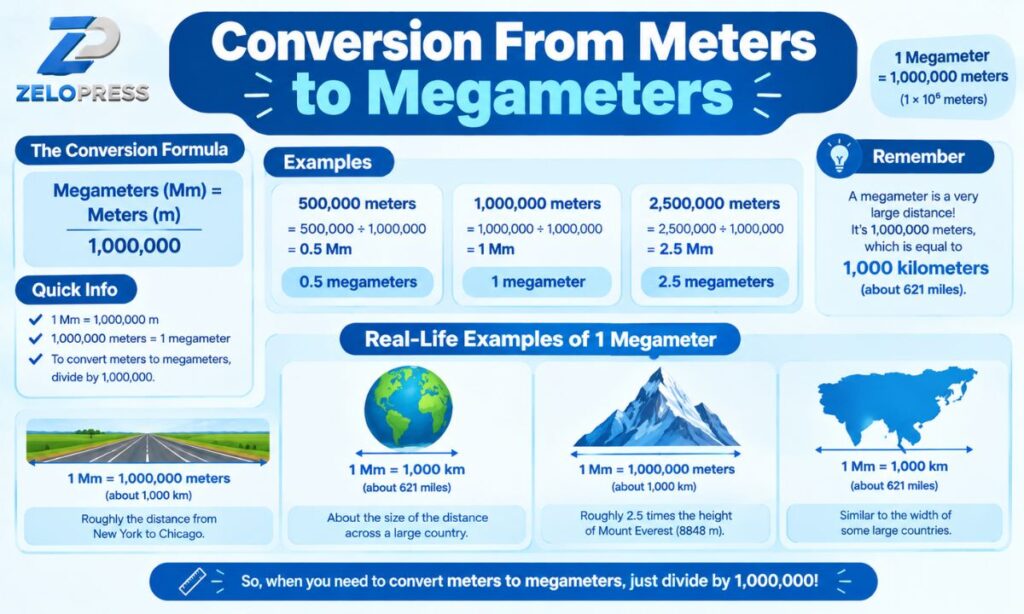
On the opposite end of the scale, a megameter (Mm) equals 1,000,000 meters. It’s rarely used in daily life but appears in geography and astronomy — for example, Earth’s diameter is roughly 12.7 megameters. To convert meters to megameters, divide the meter value by 1,000,000.
For context, here’s how the meter compares across the full range of metric length units, from smallest to largest:
| Unit | Value in Meters |
| Millimeter (mm) | 0.001 m |
| Centimeter (cm) | 0.01 m |
| Meter (m) | 1 m |
| Kilometer (km) | 1,000 m |
| Megameter (Mm) | 1,000,000 m |
Seeing the meter positioned in the middle of this scale helps explain why it’s the go-to unit for everyday, human-scale measurements — it’s neither too small nor too large for practical use.
Read More Measurement : how long is 1 meter
FAQs
Is 1 meter longer than 1 yard?
Yes, 1 meter is about 3.4 inches longer than 1 yard.
What does 1 meter look like?
1 meter looks like the width of a doorway or the length of a guitar.
How tall is 1 meter in human height?
1 meter is about as tall as an average 5-year-old child.
How many steps is 1 meter?
1 meter is about one big adult stride, or roughly 1.3 average steps.
Is 1 meter the same as 1000 millimeters?
Yes, 1 meter equals exactly 1,000 millimeters.
Summary
A meter is a simple but essential unit — equal to 100 centimeters, 1,000 millimeters, 3.28 feet, or 39.37 inches. Whether you’re picturing it through a doorway, an arm span, or a quick stride, understanding a meter visually makes metric conversions far less intimidating. Once you’ve got a mental anchor — a countertop, a guitar, a long step — you’ll never have to guess how long a meter is again.