
A scale is only as good as its last calibration. If your platform scale or heavy-duty balance reads 50kg, you need a reference mass you can trust to check it.
That is where a 50kg test weight comes in. It is a certified block of metal with a known mass, used to confirm that your scale reads true.
The number “50kg” shows up in other searches too. People ask whether it is a healthy body weight, how it converts to pounds, and whether it is heavy to lift. This guide covers both sides: the industrial 50kg weight capacity and everyday 50kg questions.
Wide Range of Single 50kg Stainless Steel Test Weights for Calibrating Scales
Single test weights are made as one piece with a defined nominal mass. A 50kg weight sits at the top end of what most calibration ranges cover.
METTLER TOLEDO lists its stainless steel knob weights under OIML classes E1, E2, F1, F2 and M1, and the stated range runs from 1mg to 20kg with 50kg shown as the extension. That makes 50kg a heavy-duty specialty size rather than a shelf item at every supplier. mt
One example is the E1 class 50kg model. It is a one-piece (monobloc) design in vacuum-melted high-grade steel, supplied with a wooden box and a calibration certificate. thelabstore
Here is a quick look at where a 50kg test weight is used:
- Floor and platform scales in warehouses
- Industrial weighing systems on production lines
- Checkweighers in packaging plants
- Laboratory reference checks for large-capacity balances
- Quality audits under ISO 9001 programs
Quick specifications of a typical E1 50kg weight
| Feature | Detail |
| Nominal value | 50 kg |
| OIML class | E1 |
| Design | One-piece (monobloc) knob weight |
| Material | Vacuum-melted high-grade steel |
| Density | 8000 (± 30) kg/m³ |
| Packaging | Wooden box |
| Certificate | ISO/IEC 17025 calibration certificate |
Source for the specifications: the supplier listing for the Mettler Toledo E1 50kg weight.
Choosing the right class matters. A higher class means a tighter tolerance. One E1 50kg weight from another maker lists a tolerance of 25 mg. That is very small for a block weighing as much as a sack of cement. labfriend
Read More Measurement : 50kg Weight Capacity
Advantages of METTLER TOLEDO’s 50kg Test Weights
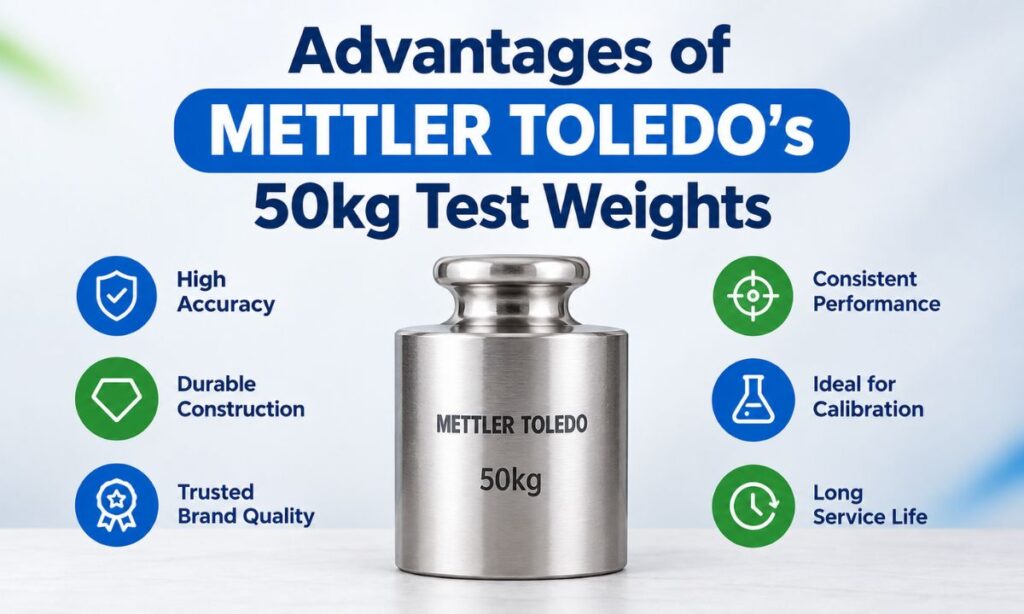
Why do labs and factories pick this brand for heavy-duty work? The benefits come down to material, certification and handling support.
Test Weights for Balances
Balances and scales drift over time. Temperature, wear and vibration all push readings off target. A test weight lets you spot that drift before it affects product quality.
The manufacturer says its stainless steel weights are made from austenitic steel chosen for the best resistance to corrosion over the weight’s life. That matters because rust or surface wear changes mass. mt
Why it helps in practice:
- You can run quick routine checks between formal calibrations
- You catch errors early and avoid rejected batches
- You build a record of scale performance over months
- You reduce the risk of failed audits
Calibration Certificate
A certificate turns a lump of metal into a traceable standard. The calibration certificate comes from the maker’s calibration lab and meets ISO/IEC 17025 requirements. thelabstore
Not every job needs one. The manufacturer notes that weights without a certificate can be acceptable in some cases, so you choose based on your own requirements. mt
But if your quality system demands proof, you need the paperwork. For example, ISO 9001 work requires documented metrological traceability, which means certified test weights. mt
With or without a certificate?
| Situation | Certificate needed? |
| ISO 9001 or other audited quality system | Yes |
| Legal-for-trade checks | Usually yes |
| Internal daily sanity check | Often no |
| Reference standard for other weights | Yes |
Protection and Durability
A 50kg weight is awkward to move, so protection matters as much as precision. The supplier lists a wooden box with the E1 model. That keeps edges safe during storage and transport.
Durability comes from the build. The process includes vacuum melting for class E1, final-stage electrolytic polishing and automated cleaning. A smooth, clean surface resists dirt and moisture, so mass stays stable longer. mt
Simple care tips:
- Always lift with the correct handling gear or a lifting aid
- Wear clean gloves and keep fingerprints off the surface
- Store the weight in its case, in a dry room
- Never drag it across a floor or place it on a dirty platform
- Recalibrate on a fixed schedule
What Is 50kg in Weight? Conversions and Everyday Context
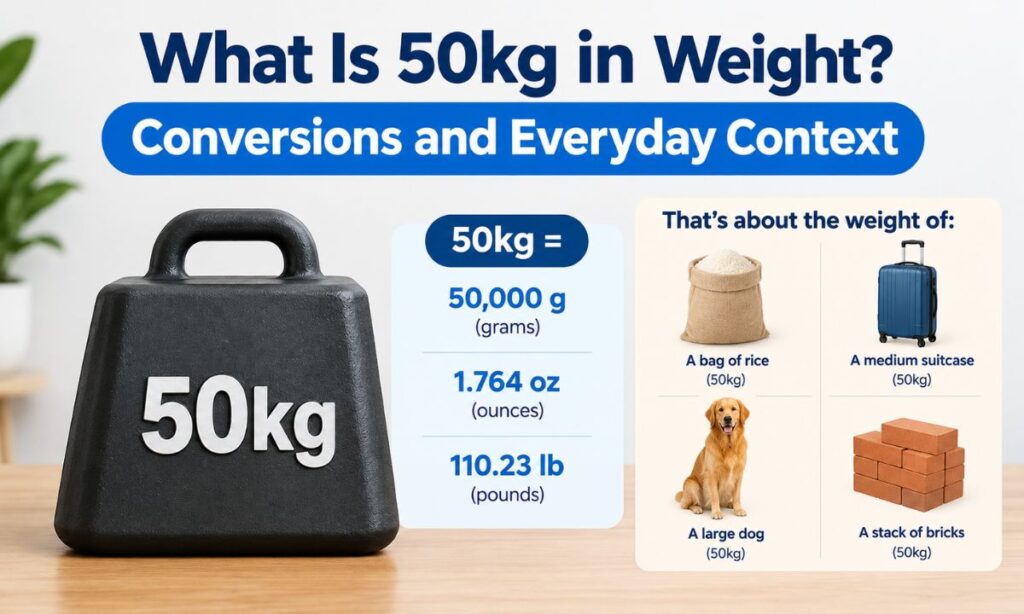
The same figure appears in very different searches. Here is the plain answer.
What Is 50kg in Weight?
50kg is fifty kilograms, or 50,000 grams. It is about the mass of a large bag of dog food, a big sack of rice, or a small adult.
Is 50kg 110 Pounds? (50 kg in lbs)
Yes. One kilogram equals about 2.20462 pounds, so 50 kg comes to roughly 110.23 lbs. automeris
Quick conversion table
| Kilograms | Pounds |
| 10 kg | 22.05 lbs |
| 20 kg | 44.09 lbs |
| 50 kg | 110.23 lbs |
| 75 kg | 165.35 lbs |
| 100 kg | 220.46 lbs |
50kg in Stone and Lbs
Dividing 110.231 pounds by 14 gives about 7.87 stone. In the UK style, that is 7 stone 12 pounds. automeris
50kg Person and 50kg Body
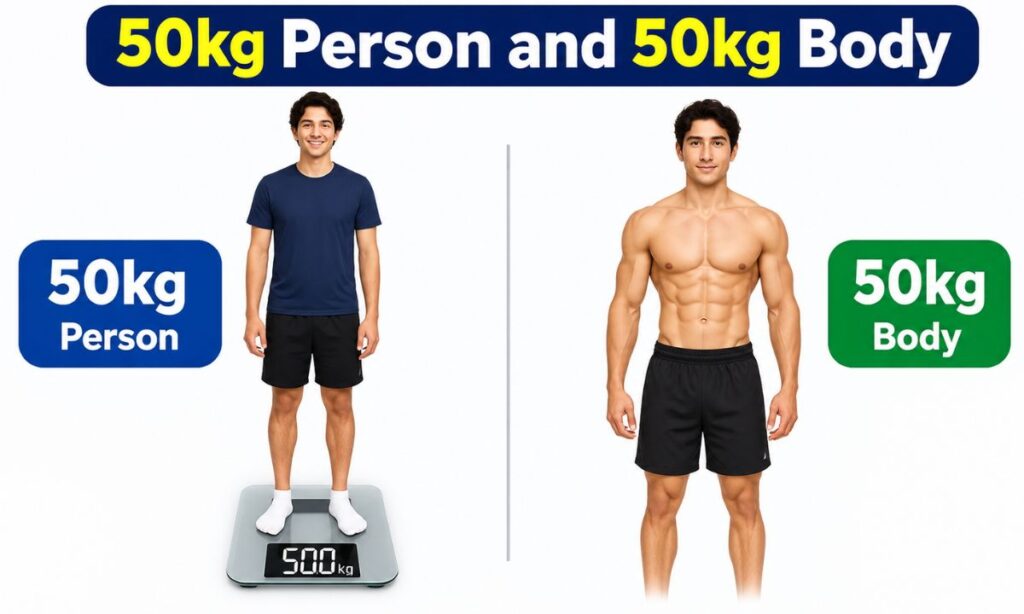
A 50kg person is lighter than the global adult average. Whether that is healthy depends on height and build. A short, slim adult may sit right in the healthy range. A tall adult at 50kg may be underweight.
BMI is the usual screening tool. A healthy BMI runs from 18.5 to 24.9. Working that out for 50kg, the healthy height range is roughly 142 cm to 164 cm (about 4’8″ to 5’4″).
A 50kg body also looks different from person to person. Muscle is denser than fat. Two people at 50kg can have very different shapes.
50kg Woman and Is 50kg Healthy for a Woman?
For many women, yes. In many countries, 50 kg sits within a healthy range for women of average height. The key words are “of average height.” automeris
Use this quick check:
- Under 142 cm: 50kg may be above the healthy BMI range
- 142–164 cm: 50kg usually falls in the healthy range
- Over 164 cm: 50kg may be underweight
BMI is only a guide. It ignores muscle, bone and age. If you are unsure, a doctor or dietitian can give personal advice.
Is 50kg OK for a 12 Year Old Girl?
Often, yes. Growth at this age varies a lot, so height and puberty stage matter more than one number. A pediatrician can check a child’s weight against a growth chart and say whether it is on track.
Is 50kg Heavy to Lift?
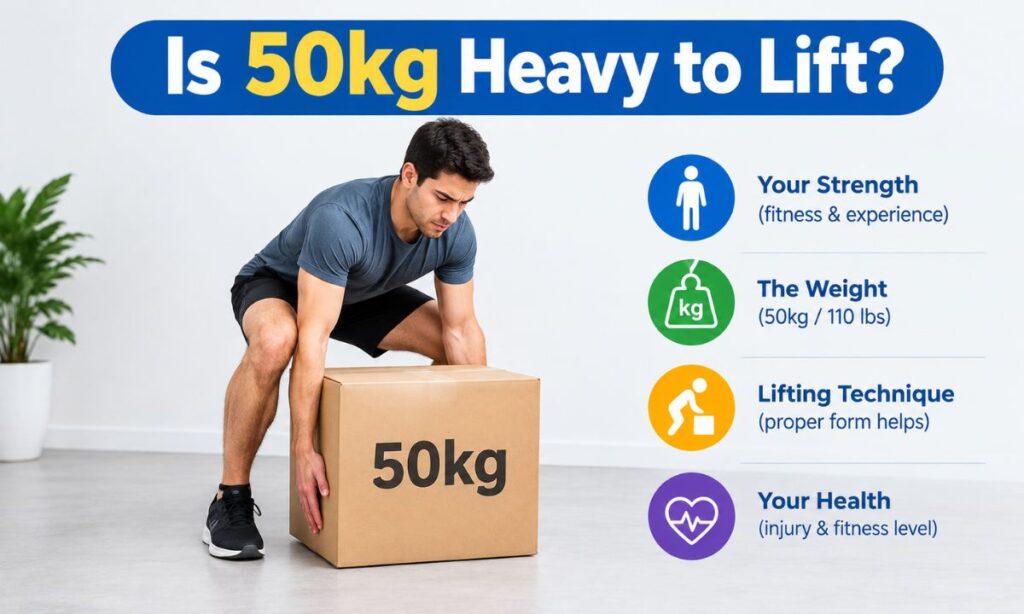
For most people, yes. Lifting 50kg from the floor is a serious load. It is about 110 pounds of dead weight.
Safety guidance for any heavy lift:
- Use two people or a mechanical aid
- Keep your back straight and bend your knees
- Hold the load close to your body
- Avoid twisting while carrying
For test weights, many workplaces set lower manual-lifting limits for a single person. Use a hoist or lifting cart for 50kg masses.
Useful Related Links
Picking and using a 50kg weight is easier with a few support tools. These are the three areas worth exploring next.
How to Select the Correct Test Weight and Weight Class
The right weight class depends on how accurate your scale must be. The manufacturer says the choice depends on the accuracy needed for your process tolerance, and it offers a free GWP® Recommendation service to name the correct weights and class. mt
A simple rule of thumb: the test weight should be much more accurate than the scale it checks.
Weight class guide
| Class | Typical use |
| E1 | Reference standards, high-end labs |
| E2 | Calibrating high-precision balances |
| F1 | Analytical and precision balances |
| F2 | Industrial scale checks |
| M1 | General industrial and commercial use |
Before you order, check three things:
- Your scale’s capacity and readability
- The tolerance your process allows
- Whether an audit requires a certificate
Weight Accessories
Handling gear protects both the weight and the user. The accessory range includes tweezers, weight forks, weight grips, gloves and cleaning cloths. For a 50kg block, lifting aids and a proper carry case matter most.
Weight Calibration Service
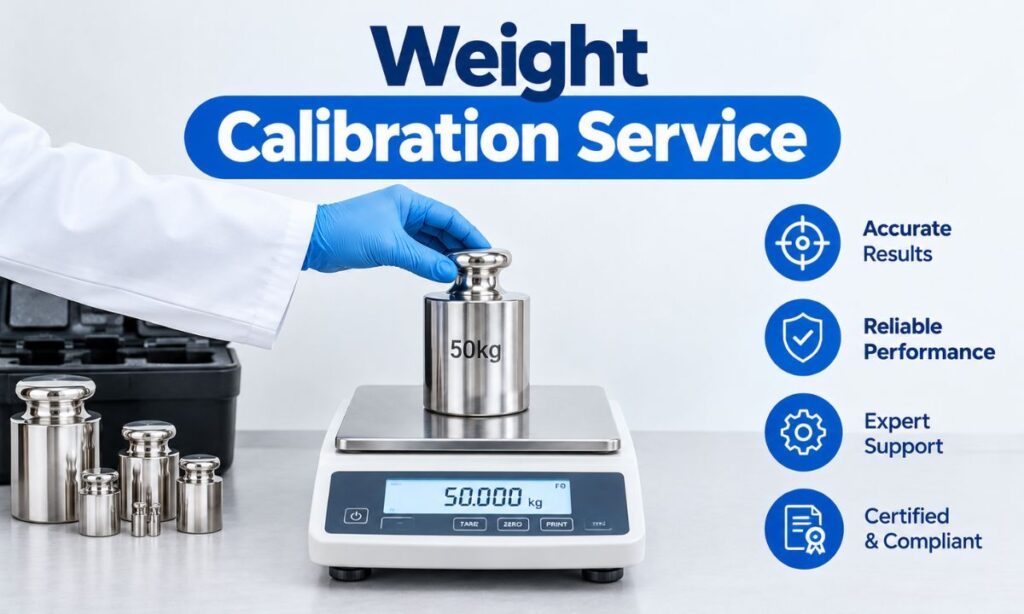
Even the best weight needs rechecking. Regular recalibration keeps its value true. The manufacturer points to a global network of accredited mass calibration laboratories with short recalibration times.
A sensible schedule:
- Check the weight on a fixed interval, often yearly
- Recalibrate sooner after damage or heavy use
- Keep every certificate in one folder for audits
Read More Measurement : 50kg Weight Capacity
FAQs
What is a 50kg test weight used for?
It checks and calibrates scales that weigh heavy loads, such as floor scales and industrial weighing systems.
Which OIML class do I need for a 50kg weight?
Pick the class based on your scale’s tolerance. E1 suits reference work, while M1 fits general industrial use.
Do I need a calibration certificate for a 50kg weight?
Only if your quality system or audits demand traceability. Routine in-house checks may not need one.
How often should a 50kg test weight be recalibrated?
Many sites do it once a year. Do it sooner if the weight is damaged or used heavily.
Is 50kg equal to 110 pounds?
Yes. 50kg is about 110.23 lbs, or 7 stone 12 pounds.
Conclusion
A 50kg weight capacity is a serious piece of equipment. Stainless steel test weights give heavy-duty scales a reliable reference, and the right class, certificate and care keep results accurate.
Match the weight class to your scale, buy a certificate when audits require it, and store the weight properly. Recalibrate on schedule.
On the personal side, 50kg is 110 pounds or 7 stone 12. Whether it is healthy depends on height and build, not the number alone.