
Converting inches to centimetres is a task that comes up constantly — whether you’re checking a TV screen size, comparing furniture dimensions, or working through a school assignment. If you’re searching for exactly how much 50 inches equals in centimetres, this guide gives you the precise answer, the formula behind it, and how the measurement applies in real life.
Whether you’re a parent tracking a child’s growth, a shopper comparing product listings from different countries, or a student learning unit conversions, this guide covers everything in one place — the exact figure, the step-by-step formula, a full conversion table, and answers to the most commonly searched related questions.
How to Convert Inch to Centimetre
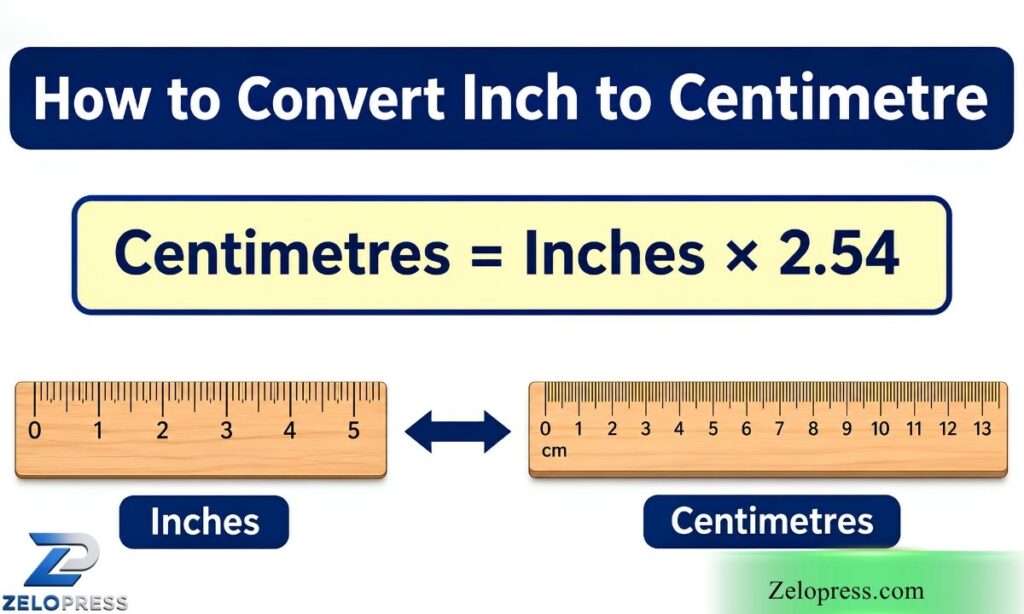
The conversion from inches to centimetres relies on a single fixed number, making it one of the simplest cross-system conversions to calculate.
What is 50 inches in feet?
50 inches equals approximately 4.17 feet, or more precisely, 4 feet 2 inches.
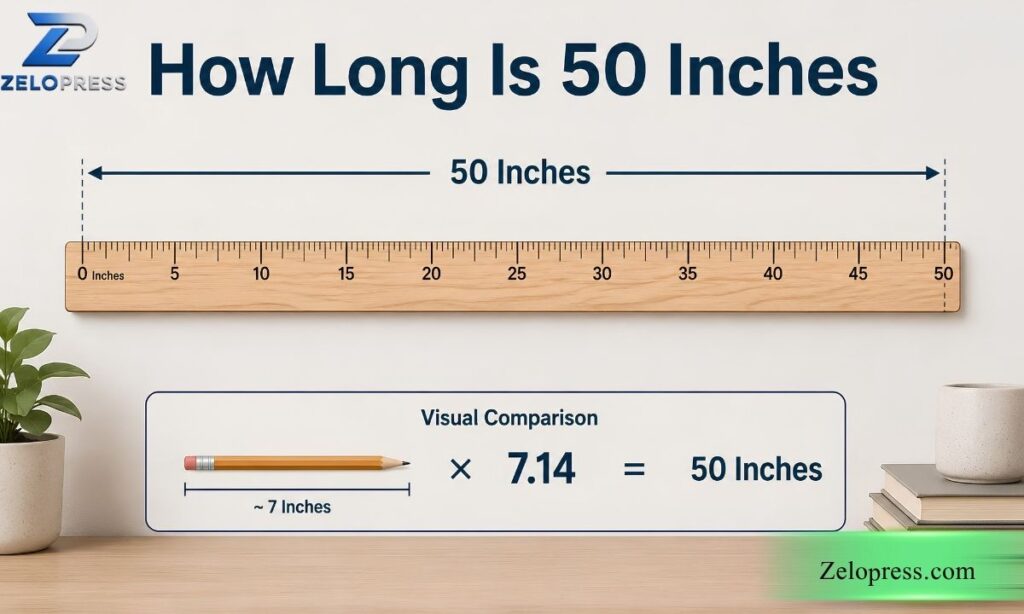
What does 50 inches look like?
Visually, 50 inches is about the height of a kitchen countertop plus a bit more, or roughly the length of a golf club. It’s a substantial length — taller than most toddlers and close to the height of a large dog standing upright.
Is 50 inches the same as 4 feet?
Not exactly. 50 inches is slightly more than 4 feet. Since 4 feet equals 48 inches, 50 inches is 2 inches longer than a full 4 feet.
Is 50 inches 5ft?
No. 50 inches is shorter than 5 feet. Five feet equals 60 inches, so 50 inches falls 10 inches short of that mark.
Read More Measurement ; how long is 50 inches
Step-by-Step: Converting Inches to Centimetres
Converting any inch measurement into centimetres follows the same simple two-step process.
Identify Your Inch Measurement
Start with the measurement you want to convert — in this case, 50 inches. This could come from a tape measure, a product listing, or a height chart.
Apply the Conversion Formula
Multiply the inch measurement by 2.54, since 1 inch equals exactly 2.54 centimetres:
50 × 2.54 = 127 centimetres
That’s the exact, precise answer — no rounding required, since the inch-to-centimetre relationship is a fixed constant.
How long is 50 inches in feet
50 inches equals 4.17 feet, or 4 feet 2 inches when expressed in feet-and-inches format.
50 inches in cm
50 inches equals exactly 127 centimetres — a clean, round number that makes this a particularly easy conversion to remember.
How long is 50 inches height
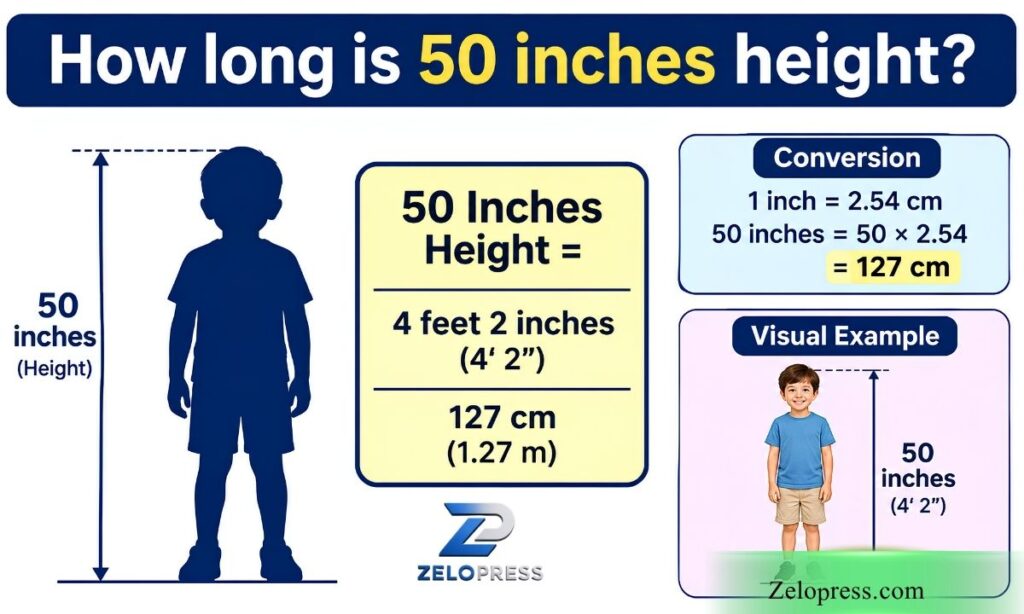
As a height, 50 inches is common for children around 8 to 10 years old, and it’s also a frequent screen-size measurement for mid-sized flat-screen TVs.
How long is 50 inches width
As a width, 50 inches (127 cm) is a common size for wide TVs, large area rugs, and wall-mounted shelving units designed to span a significant portion of a wall.
Common Uses
Fifty inches is a measurement that appears across several everyday categories:
- Television screens — 50-inch TVs are among the most popular sizes for living rooms
- Children’s height charts — many kids reach 50 inches between ages 8 and 10
- Area rugs — 50-inch widths are common for medium-to-large living spaces
- Golf clubs — driver shafts often measure close to this length
- Countertop and furniture heights — some tall furniture pieces, like bookshelves, approach this measurement
- Fencing — some residential privacy fence panels are sold in heights close to 50 inches
- Luggage dimensions — total linear dimensions (length + width + height) for checked bags are often measured against limits near this range
Because 50 inches sits right at that 127 cm mark, it’s a size you’ll encounter across shopping listings, home improvement projects, and everyday measurements more often than you might expect.
Conversion Formula & Explanation
Explanation
The inch-to-centimetre conversion is based on the internationally agreed definition that 1 inch equals exactly 2.54 centimetres. This definition has remained fixed since 1959, when the international yard and pound agreement standardized imperial and metric measurements.
Given Values
- Measurement: 50 inches
- Conversion factor: 2.54 cm per inch
Calculation Steps
- Take the inch value: 50
- Multiply by the conversion factor: 50 × 2.54
- Result: 127 centimetres
Calculation Flow
Inches → Multiply by 2.54 → Centimetres
This single-step flow applies to any inch value, making it one of the most straightforward conversions in the imperial-to-metric system.
Precision & Accuracy
Because 2.54 is an exact, defined constant (not an approximation), the result of 127 cm for 50 inches is completely precise — there’s no rounding error at any stage of the calculation.
Rounding Considerations
While 50 inches converts to an exact 127 cm, many real-world measurements aren’t round numbers. In those cases, results are typically rounded to one or two decimal places for practical use — for example, 127.3 cm rather than a long decimal string.
Common Applications
Fifty inches (127 cm) shows up in a wide range of practical contexts:
- Wide-screen televisions and computer monitors
- Curtain and drapery lengths for tall windows
- Fence panel heights in residential settings
- Area rug and carpet runner widths
- Children’s bicycle frame heights
Real-World Examples
To help visualize 50 inches in everyday terms:
- Slightly taller than a standard kitchen counter
- About the height of an 8-to-10-year-old child
- Close to the diagonal screen size of a mid-range living room TV
- Roughly the length of a golf driver
Regional Usage
Inches remain the standard unit for everyday measurements in the United States, while centimetres are the standard in most of the rest of the world, including the UK, Canada, Europe, and Asia for general use. This regional divide is exactly why conversions like “50 inches to cm” are so frequently searched — shoppers, parents, and DIYers often need to translate product listings or measurements between the two systems.
Even within countries that officially use the metric system, inches sometimes persist for specific categories — TV and monitor screen sizes are a well-known example, still commonly advertised in inches worldwide even in metric countries. This mix of conventions is part of why a reliable, exact conversion reference is so useful.
Conversion Context
Understanding this conversion is especially useful when comparing international product listings — for example, a TV advertised as “127 cm” in a European store is the exact same size as one listed as “50 inches” in the US, even though the numbers look completely different at first glance.
Inch to Centimetre Conversion Table
Here’s a quick-reference table for common inch-to-centimetre conversions near 50 inches:
| Inches | Centimetres |
| 40 in | 101.6 cm |
| 44 in | 111.76 cm |
| 48 in | 121.92 cm |
| 50 in | 127 cm |
| 52 in | 132.08 cm |
| 56 in | 142.24 cm |
| 60 in | 152.4 cm |
Reading the Table
Each row shows a fixed inch value paired with its exact centimetre equivalent. Since 1 inch always equals 2.54 cm, the centimetre values increase in steady, predictable increments as the inch value rises.
Usage Tips
- Bookmark or screenshot the table for quick reference during shopping or DIY projects
- Round centimetre results to the nearest whole number for casual, everyday use
- Keep the exact decimal figure when precision matters, such as for construction or manufacturing
Calculation Formula
For any inch value not listed in the table, use the same formula:
Centimetres = Inches × 2.54
For example, to convert 53 inches: 53 × 2.54 = 134.62 cm.
Read More Measurement ; how long is 50 inches
FAQs
How long is 50 inches?
50 inches is about 4.17 feet, or 4 feet 2 inches.
How many cm is 50 inches?
50 inches equals exactly 127 centimetres.
Is 50 inches the same as 4 feet?
No, 50 inches is 2 inches longer than a full 4 feet.
Is 50 inches 5 feet?
No, 50 inches is 10 inches short of 5 feet.
How many meters is 50 inches?
50 inches equals 1.27 meters.
Conclusion
Fifty inches converts cleanly to exactly 127 centimetres, or 4 feet 2 inches — a simple result of multiplying by the fixed 2.54 conversion factor. Whether you’re comparing TV sizes, checking a child’s height, or shopping for furniture across different measurement systems, knowing this conversion (and the easy formula behind it) makes switching between inches and centimetres quick and stress-free.