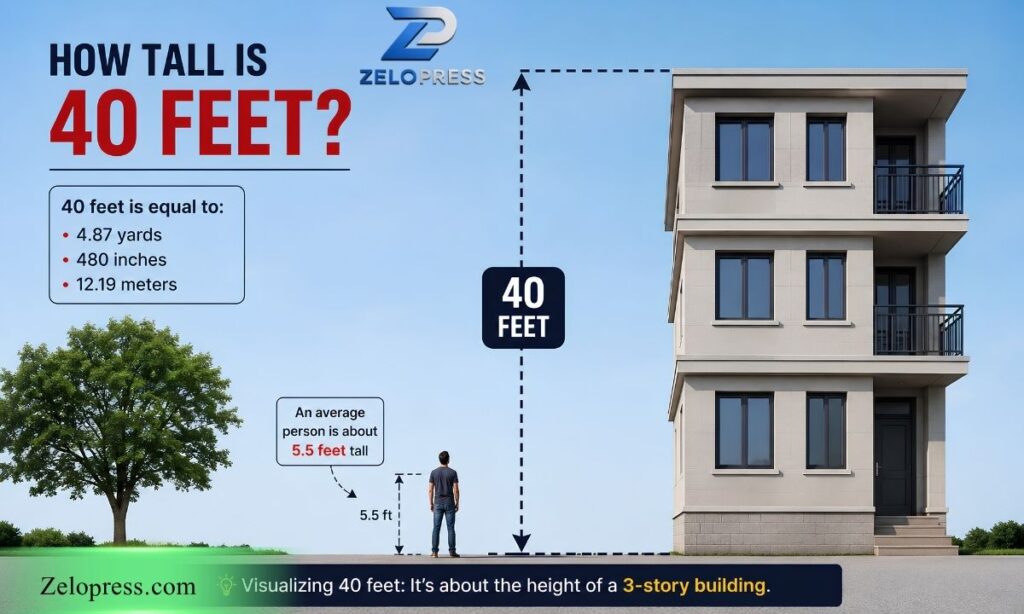

Forty feet is a length that’s genuinely hard to picture until you connect it to something physical. It’s too long to compare to furniture, but not quite large enough to compare to a football field. This guide breaks 40 feet down into exact conversions, ten real-world objects that measure this length, and simple mental tricks for estimating it without any tools at all.
Whether you’re planning a construction project, sizing up a boat purchase, or just trying to answer a curious question about scale, having concrete visual anchors makes far more sense than staring at a number alone. By the end of this guide, 40 feet will feel like a distance you can already picture in your mind.
How Long Is 40 Feet?
Forty feet equals 480 inches, 12.19 meters, or 1,219.2 centimeters. It’s a substantial length — roughly the size of a full city bus or a standard shipping container — that shows up constantly in transportation, construction, and outdoor spaces.
This measurement sits in an unusual middle ground: too large to fit inside most homes, but common enough in everyday infrastructure — buses, poles, pools, and cargo containers — that most people have already stood near a 40-foot object without ever putting a number to it.
The Exact Size of 40 Feet (Quick Breakdown)
| Unit | Equivalent to 40 Feet |
| Inches | 480 in |
| Yards | 13.33 yd |
| Meters | 12.19 m |
| Centimeters | 1,219.2 cm |
How tall is a 40 feet building?
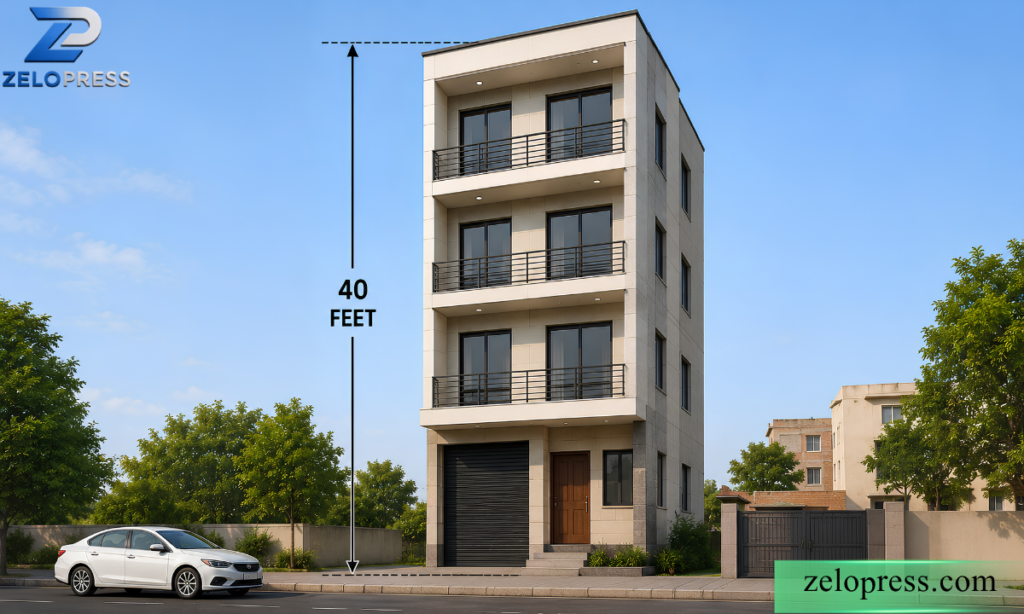
A 40-foot building is roughly equivalent to a 4-story structure, assuming an average of 10 feet per floor — a scale most people can picture by looking up at a mid-rise apartment or office building.
Read More Mesurement ; how tall is 40 feet
What is an example of 40 feet?
A standard city transit bus, a full-size shipping container, or a large recreational sailboat are all common real-world examples of something measuring 40 feet long.
What does 40 feet tall look like?

Visually, 40 feet tall looks like a mature oak tree, roughly four stacked stories of a building, or an extension ladder fully raised against a house.
What are some things that are 40 feet tall?
Common examples of 40-foot-tall structures and objects include mature shade trees, flagpoles at government buildings, telephone and utility poles, and fully extended construction ladders.
How high is 40 feet in the Air
At 40 feet in the air, you’re at a height comparable to a 4-story building’s rooftop — high enough to require fall protection on most construction sites, and roughly the maximum reach of many residential extension ladders.
What is 40 inches tall in feet
This is a smaller, related measurement worth clarifying: 40 inches equals about 3.33 feet, or 3 feet 4 inches — not to be confused with 40 feet, which is twelve times longer.
How far is 40 feet to walk
Walking 40 feet takes most adults only about 4 to 5 seconds at a normal pace — roughly the length of a large classroom or a few parking spaces.
Walk It Out: A Simple Mental Test
Here’s a quick way to feel out 40 feet using nothing but your own steps:
- Take a normal, unhurried stride — don’t exaggerate the length.
- Count each step as you walk in a straight line.
- By around 16 steps, you’ll have covered close to 40 feet.
- Turn around and look back at the distance — it’s noticeably longer than most people expect.
This simple test works well indoors in a long hallway or outdoors across a yard, giving you an instant physical sense of the measurement.
Real-World Objects That Measure Exactly 40 Feet
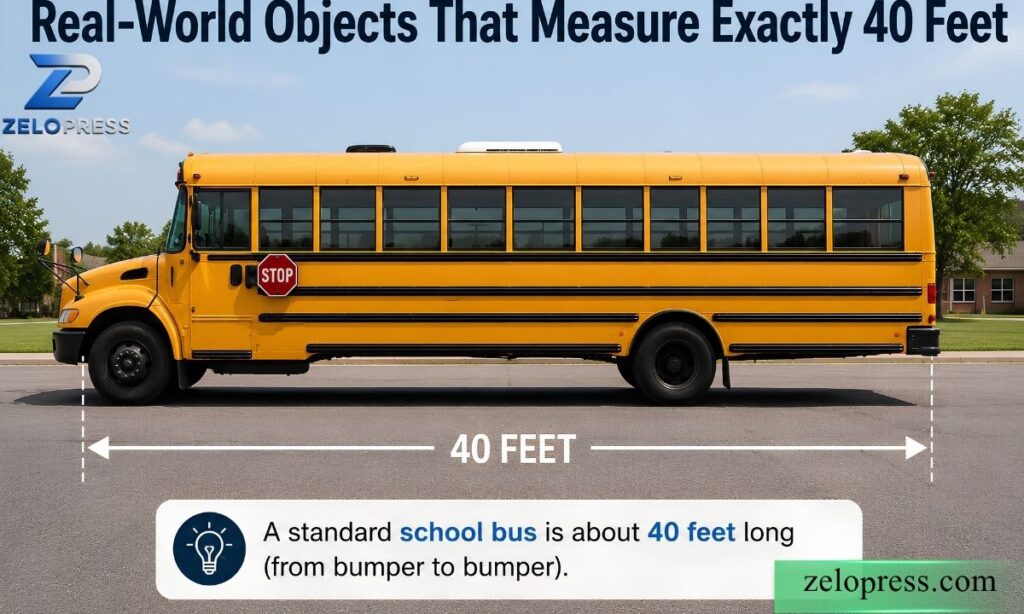
Here are ten objects and structures that measure close to 40 feet, giving you concrete anchors for the size.
1. ISO Freight Container
International shipping containers are manufactured to an exact 40-foot length under ISO standards, making them one of the most consistent real-world references for this measurement. You’ll see these stacked at ports and rail yards worldwide.
2. Full-Length City Bus
Standard public transit buses used in most major cities measure close to 40 feet from front bumper to rear bumper, making them a familiar everyday reference.
3. Semi-Trailer Container Unit
Many semi-truck trailers used for long-haul freight measure close to 40 feet in length, especially standard dry van trailers used across North America.
4. Sailing Yacht in the 40-Foot Class
Recreational sailboats and yachts in the “40-foot class” are a popular size for family cruising and coastal sailing, offering enough cabin space for extended trips.
5. Institutional Flagpole
Flagpoles at schools, government buildings, and civic centers are frequently installed at 40 feet tall, a standard height for visibility and proportion.
6. Utility Infrastructure Pole
Many wooden utility and telephone poles measure close to 40 feet, with a portion buried underground for stability and the remainder extending skyward to carry power and communication lines.
7. Residential Lap Pool Length
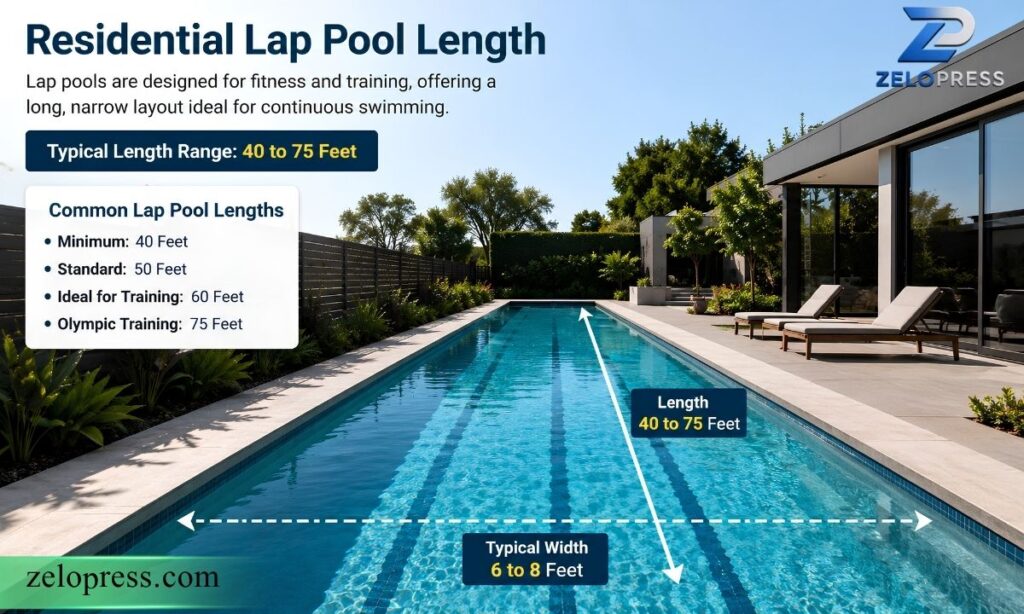
Home lap pools designed for serious swimming often measure close to 40 feet long, giving swimmers enough distance for meaningful stroke practice.
8. Modular Housing Section
Modular and prefabricated home sections, including those converted from shipping containers, are frequently built at 40 feet long to match standard transport and crane-lifting dimensions.
9. Flatbed Transport Platform
Flatbed trailers used to haul construction equipment, lumber, or steel beams often measure close to 40 feet, matching standard highway transport regulations.
10. Bridge Beam Segment
Precast concrete or steel bridge beam segments used in highway and overpass construction are frequently manufactured at 40-foot lengths for standardized transport and assembly.
How 40 Feet Feels in Different Spaces

The way 40 feet “feels” changes significantly depending on context:
- Indoors — 40 feet stretches across most large classrooms, warehouse aisles, or gymnasium widths
- Outdoors — it’s roughly the width of a suburban house lot’s frontage in many neighborhoods
- On the road — it’s the length of a full-size bus or semi-trailer passing by
- In the air — it’s about the height of a 4-story building’s roofline
Vertical vs Horizontal Perspective
Forty feet measured horizontally (like a bus or shipping container) tends to feel more manageable, since we’re used to seeing long vehicles and structures at ground level. Measured vertically (like a building height or a mature tree), the same distance often feels far more dramatic, since most people rarely look straight up to gauge height accurately.
Comparing 40 Feet to Other Sizes
Seeing 40 feet next to other familiar distances helps put the measurement in context:
| Reference | Length | How 40 Feet Compares |
| Basketball court (NBA) | 94 feet | 40 feet is under half the court’s length |
| Bowling lane | 60 feet | 40 feet is about two-thirds of the lane |
| Tennis court | 78 feet | 40 feet is close to half the court’s length |
| Average car | 10–12 feet | Roughly four cars parked end to end |
We have more guides on feet for you to make measurements easy to understand:
- How Long Is 20 Feet?
- How Long Is 30 Feet?
- How Long Is 50 Feet?
- Feet to Meters Converter
Estimating 40 Feet Without Tools

If you don’t have a tape measure handy, try these simple estimation methods:
- Count your steps — roughly 16 average adult strides covers close to 40 feet.
- Use a known vehicle — a city bus or semi-trailer passing by is a near-exact 40-foot reference.
- Compare to a building — four stacked stories of a typical building is close to 40 feet tall.
- Use a garden hose or extension cord — many are sold in 25 or 50-foot lengths, so a 40-foot stretch falls between the two.
- Use a smartphone measuring app — AR-based tools can give a reasonably close estimate for casual use.
Read More Mesurement ; how tall is 40 feet
FAQs
How tall is 40 feet?
40 feet is about the height of a 4-story building.
How many meters is 40 feet?
40 feet equals approximately 12.19 meters.
How many stories is 40 feet?
40 feet is roughly 4 stories, assuming 10 feet per floor.
How many inches is 40 feet?
40 feet equals exactly 480 inches.
What is 40 feet tall compared to a tree?
A mature oak or shade tree commonly reaches close to 40 feet tall.
Conclusion
Forty feet might sound abstract as a number, but once you connect it to things you’ve actually seen — a city bus, a shipping container, a 4-story building, or even 16 of your own footsteps — it becomes an easy length to picture instantly. Whether you’re planning a construction project, sizing up a boat, or just curious how this measurement stacks up in real life, these real-world comparisons make 40 feet simple to visualize without ever needing a tape measure.