
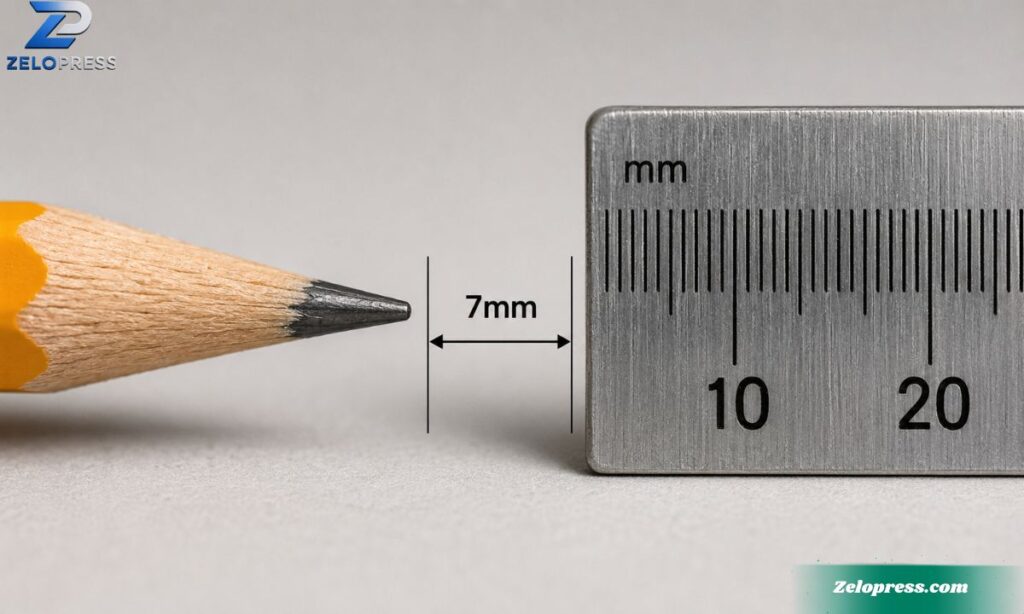

Millimeters are one of those units everyone has heard of but almost nobody can picture on command. Ask someone how big 7mm is, and you’ll usually get a shrug or a vague hand gesture. That’s fair — 7mm is small enough that most of us never need to measure it with a ruler, yet it shows up constantly in things we touch every day.
This guide breaks down exactly how big 7mm is using objects you probably already own, plus a few simple tricks to estimate it without any measuring tools at all.
How Big Is 7mm?
Seven millimeters is a small linear measurement equal to 0.7 centimeters, or roughly 0.28 inches. It sits comfortably between “barely noticeable” and “clearly visible” — big enough to see and handle with ease, but too small to measure accurately just by eyeballing it.
To put it in context:
- 7mm is about the width of a standard pencil eraser
- It’s roughly the thickness of ten sheets of printer paper stacked together
- It’s close to one-third the width of an adult’s fingertip
Millimeters matter more than people realize. Jewelry sizing, screw specifications, phone components, and even seed and produce sizing charts are all commonly listed in millimeters, which is exactly why having a mental reference for 7mm is genuinely useful.
Also Read This Mesurement ; 7mm size comparison
Ways to Measure 7mm Without a Ruler
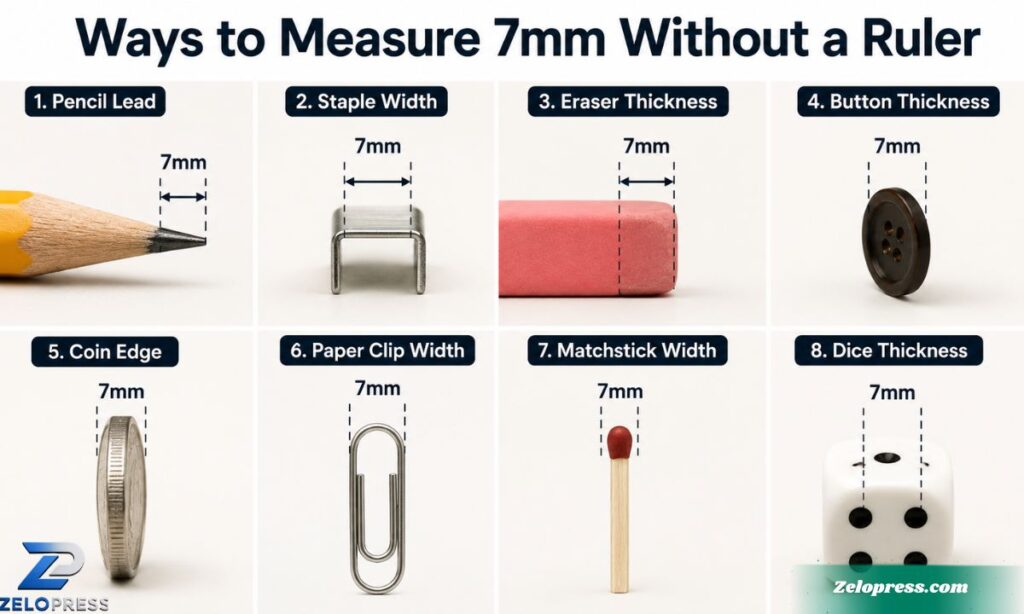
Not every situation gives you access to a tape measure. Luckily, your body and your wallet can both act as rough measuring tools when you need a quick estimate.
What size does 7mm look like?
Picture a single kernel of corn or a small garden pea sitting on a table. That rounded, pinch-sized shape is a good visual anchor for 7mm. It’s large enough to pick up between two fingers without effort, but small enough that you’d never mistake it for something an inch or more across.
Is 7 mm small?
Yes — on the scale of everyday objects, 7mm counts as small. It’s larger than a grain of rice or a pinhead, but noticeably smaller than a coin, a bottle cap, or a standard button. In practical terms, it’s the kind of size that’s easy to lose in a couch cushion but easy to spot once you know what you’re looking for.
Using Your Fingers
Your own hands can double as a rough measuring tool:
- The width of a pinky fingernail (measured near the tip) is often close to 7mm
- The tip of an index finger, measured just above the first knuckle crease, is a similar width
- A gentle pinch between your thumb and forefinger, holding them just barely apart, approximates this gap
This method won’t give you lab-level accuracy, but it’s a fast way to estimate size while shopping or crafting when no ruler is handy.
Using Coins
Coins are one of the most reliable “instant rulers” because their sizes are standardized and consistent. While no single common coin is exactly 7mm across, you can use coin thickness as a helpful reference:
| Coin | Approximate Thickness |
| US Penny | 1.52mm |
| US Nickel | 1.95mm |
| US Dime | 1.35mm |
| US Quarter | 1.75mm |
Stack about four to five standard US coins on top of one another, and the resulting height lands close to 7mm. This trick is especially handy when you need a quick physical reference and don’t want to pull out a measuring tool.
What does 7mm look like on a ruler?
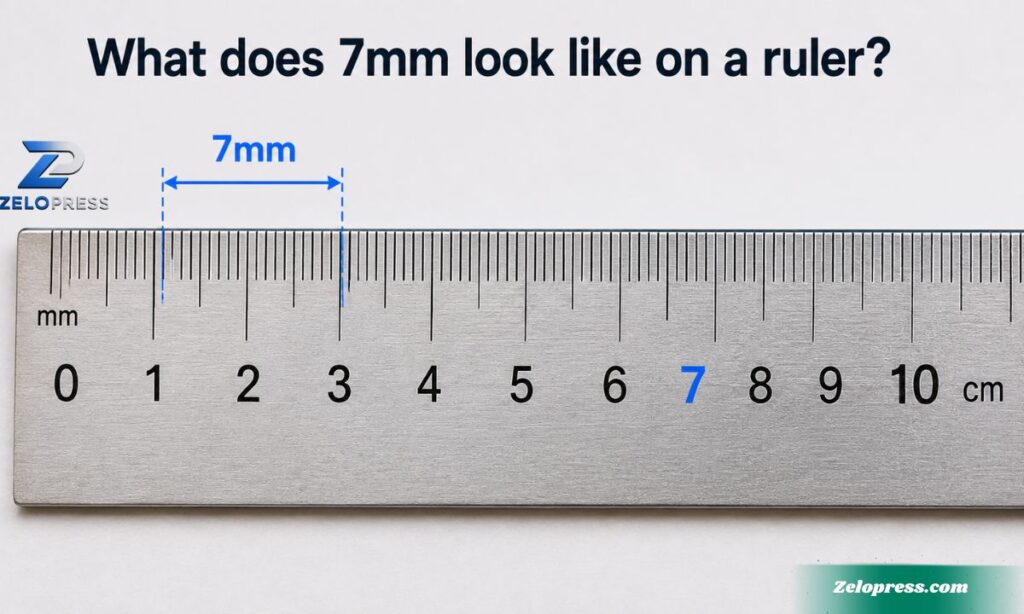
On a standard metric ruler, 7mm falls just before the 1-centimeter mark. If you’re looking at the small tick marks between the “0” and “1” lines on a centimeter ruler, 7mm is the seventh tiny line — very close to, but not quite touching, the 1cm mark.
On an imperial ruler, since there’s no millimeter markings, you’d look just under the 5/16-inch mark, since 7mm falls almost exactly at that point.
7mm to inches
Converting millimeters to inches is simple once you know the formula:
7mm ÷ 25.4 = 0.2756 inches
Rounded for everyday use, 7mm is approximately 0.28 inches, or just a touch smaller than 5/16 of an inch. This conversion is especially useful when comparing product listings that use different measurement systems, such as jewelry, drill bits, or hardware components.
Using Everyday Items
Beyond fingers and coins, several household items double as handy size references for 7mm:
- A standard drinking straw’s diameter is close to this size
- A stack of two standard SIM cards
- The width of a AAA battery’s flat end
- A small paperclip bent into a loop
Keeping a mental list like this makes it far easier to visualize measurements without needing a tool every time.
Quick Table of Common Things That Are 7mm Big
| Object | Approximate Size |
| Pencil eraser thickness | 7mm |
| Small garden pea | 6–8mm |
| Jewelry bead (small/medium) | 7mm |
| Phone charging pin width | 6.5–7mm |
| Standard shirt button thickness | 7mm |
| Small marble | 7–8mm |
| Screw head diameter (small hardware) | 7mm |
| Blueberry width | 6–8mm |
| Earbud speaker opening | 7mm |
Pencil Eraser Thickness
Most standard pencil erasers, especially the pink cap-style erasers found on classic wooden pencils, measure close to 7mm in thickness when viewed from the side. This makes the humble pencil eraser one of the easiest reference points for visualizing this measurement, since almost everyone has one within arm’s reach. Next time you’re holding a pencil, take a second look at the eraser end — that’s roughly your 7mm benchmark.
Small Pea
A fresh, average-sized garden pea typically measures somewhere between 6mm and 8mm across, putting a good number of peas right at the 7mm mark. Because peas are round, familiar, and easy to hold, they’re one of the most commonly used comparisons for this size in cooking and gardening contexts. If you’ve ever shelled peas for dinner, you’ve already handled dozens of near-perfect 7mm examples.
Jewelry Bead
In beading and jewelry-making, a 7mm bead is considered a small-to-medium size — noticeably bigger than tiny seed beads, but smaller than statement beads used in chunky necklaces. This size is popular for bracelets and layered necklaces because it’s substantial enough to see clearly on a strand but not so large that it looks bulky. If you’ve ever shopped for beads online, “7mm” is a listing size you’ll come across often.
Phone Charging Pin Width
Many smartphone charging ports and connector pins measure close to 7mm in width, particularly USB-C style connectors. This size allows the connector to be slim enough for thin phone bodies while still being sturdy enough to handle repeated daily plugging and unplugging. It’s a good example of how millimeter precision matters in manufacturing, since even a fraction of a millimeter off can mean a cable doesn’t fit properly.
Standard Shirt Button Thickness
The topmost collar button on a dress shirt is often around 7mm across. In tailoring, buttons in this range are chosen deliberately — big enough to grip and fasten with ease, but small enough to stay discreet against a collar or cuff. This is one of those measurements hiding in plain sight on clothing you might be wearing right now.
Small Marble
Smaller marbles used in classic games and craft projects tend to fall in the 7mm to 8mm range, sitting just below the “standard” marble size most people picture. These smaller marbles are common in mosaic art, vase fillers, and children’s toys, offering a satisfying, tactile way to feel out this measurement with your fingers.
Screw Head Diameter
Many small hardware screws — the kind used in eyeglasses, electronics, and small furniture fittings — have head diameters close to 7mm. This size shows up often in flat-pack furniture assembly and small appliance repairs, which is why keeping a small screwdriver set on hand is so useful for anyone doing DIY projects at home.
Blueberry Width
A typical fresh blueberry measures somewhere between 6mm and 8mm in width, depending on ripeness and variety. Since blueberries are round, small, and available almost everywhere, they make an excellent produce-aisle reference for this size — easy to picture even without one in hand.
Earbud Speaker Opening
The small speaker openings found in many wired and wireless earbuds are often close to 7mm across. This size balances sound quality with the compact design needed to fit comfortably inside the ear canal, making it a practical engineering constraint as much as a measurement one.
Also Read This Mesurement ; 7mm size comparison
FAQs
How big is 7mm compared to an inch?
7mm is about 0.28 inches, or roughly one-third of an inch.
What everyday object is 7mm?
A pencil eraser and a small garden pea are both close to 7mm.
Is 7mm bigger or smaller than a penny?
7mm is smaller than a penny, which measures about 19mm across.
How do I measure 7mm without a ruler?
Stack four to five standard coins on top of each other, or use the width of your pinky fingernail.
Is 7mm the same as 0.7 cm?
Yes, 7mm equals exactly 0.7 centimeters.
Summary
Seven millimeters may sound like an abstract number, but it’s a size you interact with constantly — from the eraser on your pencil to the button on your shirt collar. By comparing it to everyday items like peas, beads, and coins, it becomes much easier to visualize and estimate without ever needing a ruler. The next time you come across a 7mm measurement on a product label, you’ll have a real mental picture to match it to.