
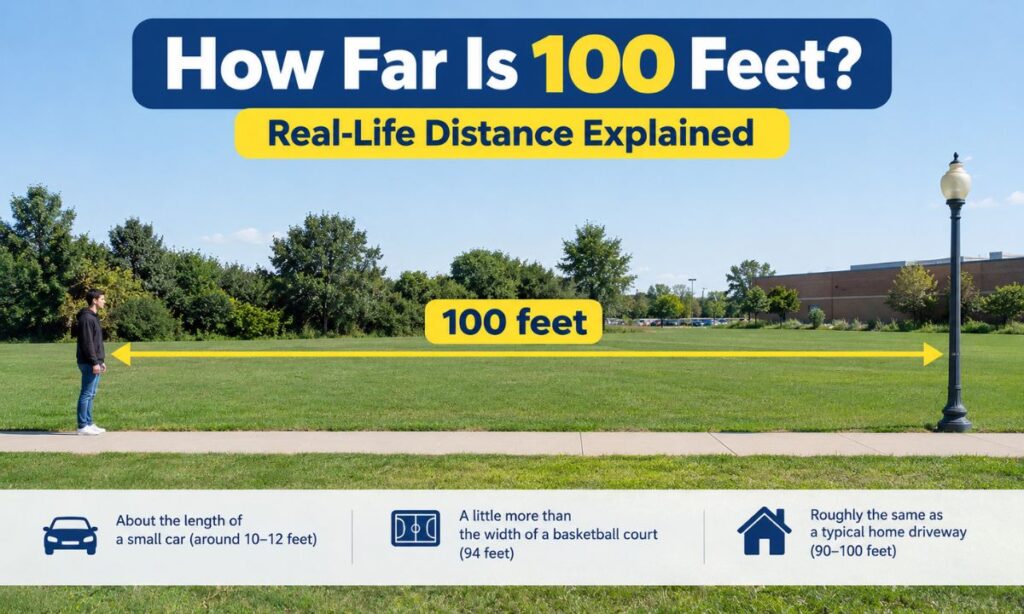

How far is 100 feet? It is exactly 30.48 meters, or about one third of a football field. That is roughly ten car lengths parked bumper to bumper, or a ten-story building stood on its end.
The number sounds simple. Picturing it is harder. Most people guess too short when they look across a yard, a parking lot or a street. This guide gives you the conversions first, then 17 real-world comparisons, a few field tricks for estimating distance, and quick answers to common questions.
The Numbers at a Glance
Here is 100 feet in every unit you are likely to need.
| Unit | 100 feet equals |
| Inches | 1,200 in |
| Yards | 33.33 yd |
| Meters | 30.48 m |
| Centimeters | 3,048 cm |
| Kilometers | 0.03048 km |
| Miles | 0.0189 mi |
A few quick benchmarks help too:
- Walking: About 40 steps, or 20 to 25 seconds at an easy pace.
- Height: Roughly 8 to 10 building stories.
- Cars: About six or seven mid-size sedans in a row.
17 Real Things That Are About 100 Feet Long or Tall
Some of these match 100 feet closely. Others are near misses that still give you a useful mental ruler. I note the difference as we go.
Read More Measurement : How Far Is 100 Feet
1. Niagara Falls (Horseshoe Falls Drop)
The Horseshoe Falls drop is commonly given as somewhere between 165 and 190 feet, depending on where you measure. So 100 feet is a little more than half of that plunge. Stand at the railing and picture the top 100 feet of water.
How far is 100 feet on a football field?
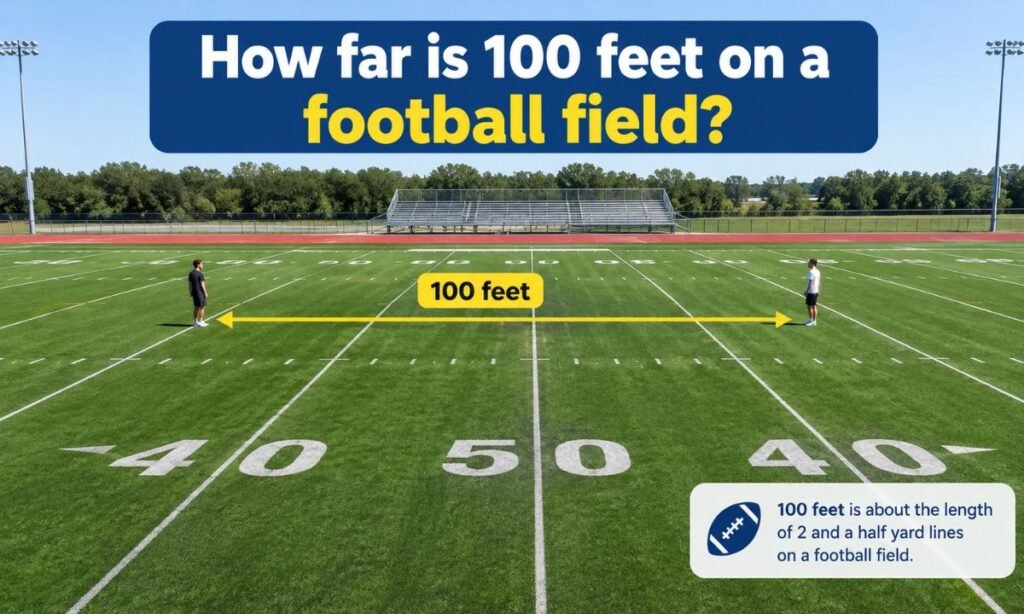
An American football field is 300 feet from goal line to goal line, so 100 feet is 33.3 yards. That is the distance from the goal line to about the 33-yard line.
How far is 100 feet in miles?
100 feet is about 0.0189 miles. Put another way, it takes roughly 53 of these stretches to make one mile.
How tall is 100 feet compared to a human?
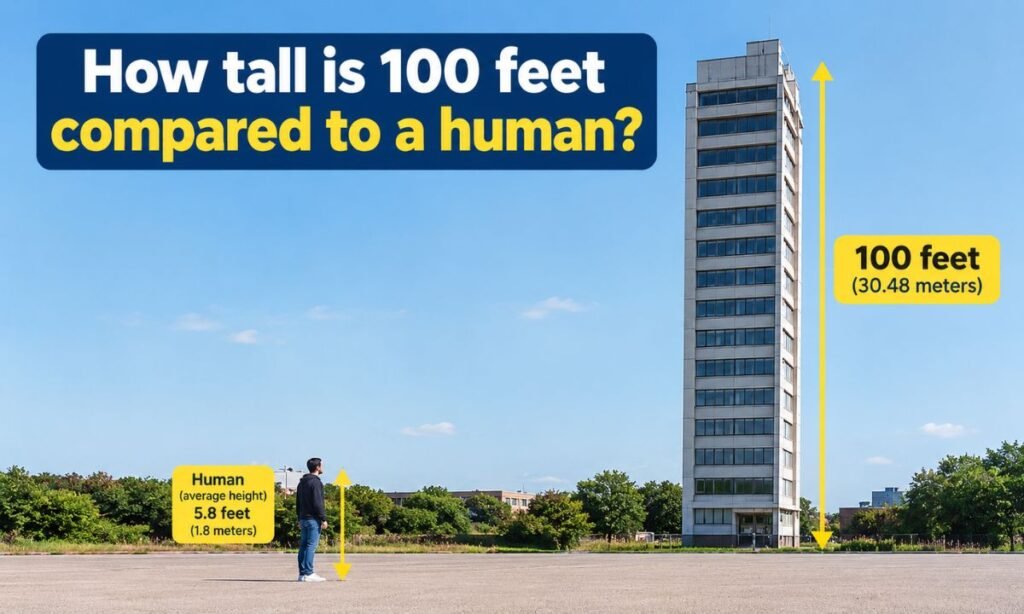
An adult around 5 feet 9 inches tall is about 17 or 18 people standing head to toe.
How tall is a 100 feet building?
With typical floor heights of 10 to 12 feet, a 100-foot building has about 8 to 10 stories.
2. A Tall Commercial Flagpole

Most flagpoles outside businesses run 20 to 40 feet. Go much taller and you reach the giant poles at car dealerships and highway exits, and some of those hit 100 feet. If you can spot a flag from far down the road, you are probably looking at one of these.
3. Five or Six Adult Giraffes Stacked
A tall giraffe stands about 16 to 19 feet. You would need five or six of them, stacked head to hoof, to reach 100 feet. It is a silly image, and it sticks.
4. Three Volleyball Nets Laid End to End
A regulation volleyball net is roughly 32 feet long. Lay three in a line and you land just under 100 feet. A full volleyball court is only about 59 feet long, so this one is bigger than it sounds.
5. The Height of a Mature Coconut Palm

Coconut palms usually reach 50 to 80 feet. The tallest on tropical beaches can approach 100 feet. Next time you look up at one, you are seeing the limit of this measurement.
6. Statue of Liberty’s Pedestal
The pedestal alone is about 89 feet tall, so it is close to 100 feet. Add the base and the statue itself, and the full monument is well over 300 feet.
100 feet to meter square
Feet measure length, and square meters measure area, so the two do not convert directly. If you mean 100 square feet, that equals about 9.29 square meters.
100 feet to meters
100 feet is 30.48 meters. For a quick mental figure, multiply feet by 0.3.
How long is 100 ft of LED lights?
A 100-foot LED strip is about 30.5 meters. Strips usually come in 5-meter reels, so you will need about six. Longer 12-volt runs often dim at the far end, so plan on adding extra power connections along the way.
How far is 50 feet?
50 feet is 15.24 meters, exactly half of 100 feet. It is about the length of a large school bus plus a car.
7. A Baseball Base Path, Plus Ten Feet
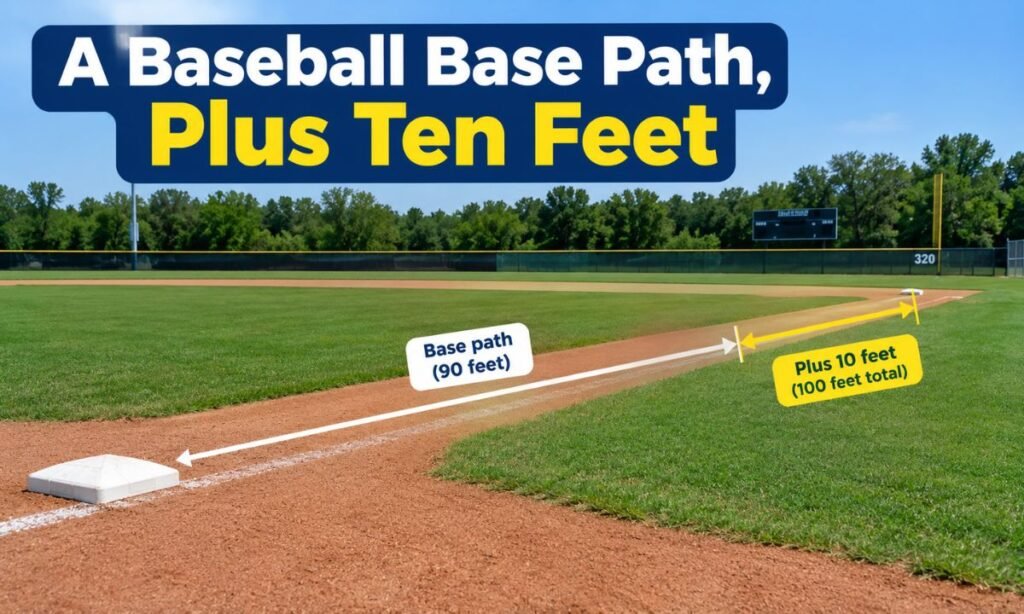
The bases on a regulation baseball diamond are 90 feet apart. Add ten feet and you have 100. A runner sprinting from first to second covers almost this exact distance.
8. A Center Pivot Irrigation Span
Those long wheeled sprinklers crossing farm fields are built in sections. A single span commonly runs around 100 to 200 feet. The shorter spans are close to our number.
9. The Length of a Main Dock at a Marina
Finger piers beside each boat slip are short, often 20 to 40 feet. The main walkway they attach to is a different story. Many marina main docks run 100 feet or more. Walking one end to end is a decent real-world test.
10. A Rockefeller Center Christmas Tree
The famous New York tree usually stands 75 to 90 feet tall. The record holder, a Norway spruce delivered in 1999, reached about 100 feet. It is one of the few times a living tree has hit this mark on purpose.
11. Three Olympic Diving Towers

The top platform in Olympic diving is 10 meters, or about 33 feet. Stack three of them and you reach roughly 100 feet. Divers hit the water from the first one at around 30 mph.
12. A Typical Covered Bridge
Spans vary a lot. Many historic covered bridges in New England and the Midwest cross creeks at lengths near 100 feet. A few famous ones are much longer, so check any specific bridge before you quote it.
13. Eleven Parking Spaces Side by Side
A standard space is about 9 feet wide. Eleven of them in a row measure about 99 feet. Next time you are in a big lot, count the stripes. This is one of the easiest comparisons to find.
14. About Half of Cinderella Castle
Cinderella Castle at Walt Disney World’s Magic Kingdom is about 189 feet tall. The lower half, up to roughly the top of the main turrets, gives you a good sense of 100 feet of height.
15. The Wingspan of a Boeing 737-800

The wingspan is about 112 feet, or around 117 feet with winglets. It is a bit more than 100, but when you look at a plane on the tarmac, that is the right order of magnitude.
16. A Standard Rope Rescue Line
Rescue, utility and throw ropes are often sold in 100-foot lengths. Pull one out of a coil and lay it across a field. That gives you a hands-on feel for the distance, and also for how heavy it gets.
17. The Distance a Cheetah Covers in One Second
At a full sprint, a cheetah runs roughly 60 to 70 miles per hour. That is close to 100 feet every second. You have barely started counting when it has already crossed the entire length.
How to Estimate 100 Feet Without a Tape Measure
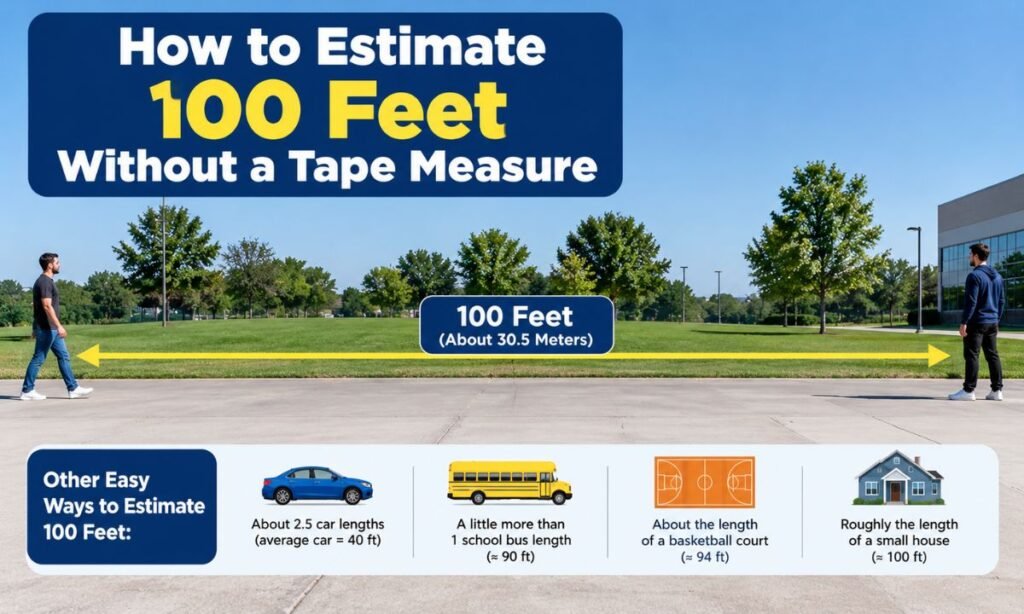
You do not need a measuring tool. Try one of these:
- Count your steps. The average adult step is about 2.5 feet. Take 40 steps and you have 100 feet. Test your own stride once to make it more accurate.
- Use car lengths. A typical sedan is 14 to 16 feet. Picture six or seven in a line.
- Use parking spaces. Eleven in a row is about 100 feet.
- Use a thumb at arm’s length. Hold your arm out and compare your thumb to a known object, then repeat. It is rough but works in a pinch.
- Use a fence or utility poles. Poles are often spaced 100 to 125 feet apart in residential areas.
Whichever method you choose, measure the real distance once. After that, your eye gets much better.
100 Feet in Everyday Situations
Here is where this distance shows up in real life.
- Home projects: Garden hoses and extension cords often come in 100-foot lengths. Measure twice before you buy, because it is further than it looks.
- Wi-Fi: A typical home router covers up to about 100 feet indoors, though walls cut that down quickly.
- Property lines: Many city lots are 100 feet deep. A 100-foot setback is a big deal on a small lot.
- Boating: In shallow water, you let out about 100 feet of anchor line to hold a boat in place.
- Safety: Some fire codes and safety rules use 100 feet as a standard clearance or reach distance.
- Sports: A basketball court is 94 feet long. 100 feet is just a little more.
Read More Measurement : How Far Is 100 Feet
FAQs
How many steps is 100 feet?
About 40 steps for the average adult, assuming a stride of roughly 2.5 feet.
How long does it take to walk 100 feet?
At a normal pace of about 3 miles per hour, it takes around 23 seconds.
How many yards is 100 feet?
100 feet equals 33.33 yards, because there are 3 feet in a yard.
Is 100 feet the same as 100 yards?
No. 100 yards is 300 feet, which is the length of a football field.
How many car lengths is 100 feet?
About six or seven average cars, since most sedans are 14 to 16 feet long.
Conclusion
100 feet is 30.48 meters, 33.33 yards, and about a third of a football field. Once you link it to things you already know, such as car lengths, parking spaces or a ten-story building, you stop guessing and start seeing it.
Pick two or three comparisons from this list and keep them in your head. The next time you are buying cable, planning a fence or just curious, you will have a quick, reliable way to size things up.