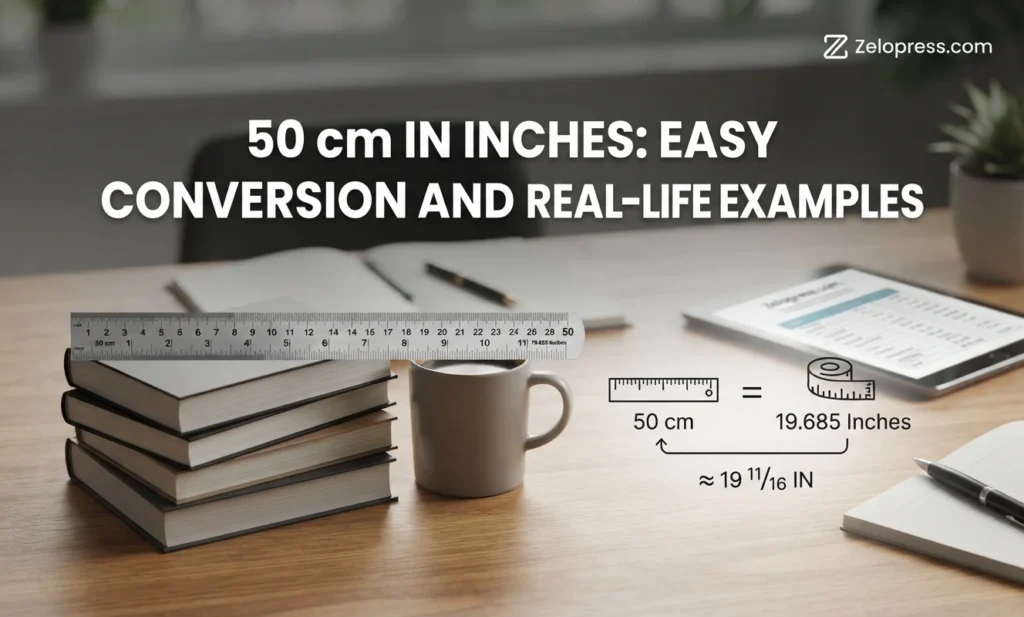

50 cm equals about 19.69 inches. That’s just under 20 inches, or roughly 1 foot 7.7 inches.
You might need this number when you shop for furniture, read a size chart or follow a sewing pattern. This guide covers the math, other units and easy ways to picture the length.
Understanding What 50 cm Represents
Fifty centimeters is exactly half a meter. A centimeter is one hundredth of a meter, so 50 of them make 50/100 of a meter.
The number can describe different dimensions:
- Length: a 50 cm piece of ribbon
- Width: a 50 cm shelf
- Height: a 50 cm side table
- Diagonal: a screen measured corner to corner
- Circumference: a 50 cm measurement around an object or body
Check which dimension a label means. A 50 cm wide box and a 50 cm tall box may fit very different spaces.
Exact Conversion of 50 cm to Inches
50 cm is 19.68503937 inches, shown to eight decimal places. The decimals continue, so most people round the result.
| Format | 50 cm in inches | Best for |
| One decimal place | 19.7 in | Quick estimates |
| Two decimal places | 19.69 in | General use |
| Three decimal places | 19.685 in | More detailed work |
| Nearest 1/16 inch | 19 11/16 in | Reading a tape measure |
| Nearest 1/8 inch | 19 5/8 in | Coarser ruler markings |
The fraction 19 11/16 inches equals 19.6875 inches. It’s only 0.0025 inch longer than the converted value.
The Formula for Converting Centimeters to Inches
To convert cm to inches, divide by 2.54. This works because one inch equals 2.54 centimeters.
Inches = centimeters ÷ 2.54
- Start with the length: 50 cm.
- Divide it by 2.54.
- Get 19.685 inches.
- Round to 19.69 inches.
You can also multiply by 0.393701. To reverse the conversion, multiply inches by 2.54.
50 cm in Inches and Feet

50 cm is about 1 foot 7.69 inches. In decimal feet, it’s about 1.64 feet.
To split the result, subtract 12 inches from 19.685. You have one full foot with 7.685 inches left over. Don’t read 1.64 feet as 1 foot 6.4 inches. The decimal is a fraction of a foot.
Read More Measurement : How Big Is 8 Inches? Real-Life Size Comparisons & Examples
50 cm in Inches for a TV
A 50 cm screen diagonal is about 19.7 inches. TV and monitor sizes usually refer to the visible screen from one corner to the opposite corner.
For a 16:9 screen with a 50 cm diagonal, the picture area is about:
| Dimension | Centimeters | Inches |
| Diagonal | 50 | 19.7 |
| Width | 43.6 | 17.2 |
| Height | 24.5 | 9.7 |
The frame and stand add to the outside size. Check the full product dimensions before buying furniture or a wall mount.
Don’t confuse a 50 cm screen with a 50-inch TV. A 50-inch diagonal equals 127 cm.
50 × 50 cm in Inches
50 × 50 cm is about 19.69 × 19.69 inches. This describes a square, such as a cushion cover or floor tile.
Its area is 2,500 square cm, about 387.5 square inches or 2.69 square feet. For area, don’t simply divide square centimeters by 2.54. Divide by 6.4516 to get square inches.
An Alternative Way to Convert Quickly
For mental math, multiply centimeters by 0.4:
50 × 0.4 = 20 inches
A simple way to do this is to multiply by 4, then divide by 10. The estimate is about 0.31 inch too high.
For a closer answer, take 20 and subtract about 0.3. That gives you 19.7 inches. The shortcut is fine for browsing, but use 2.54 for a tight fit.
Visualizing the Length of 50 cm
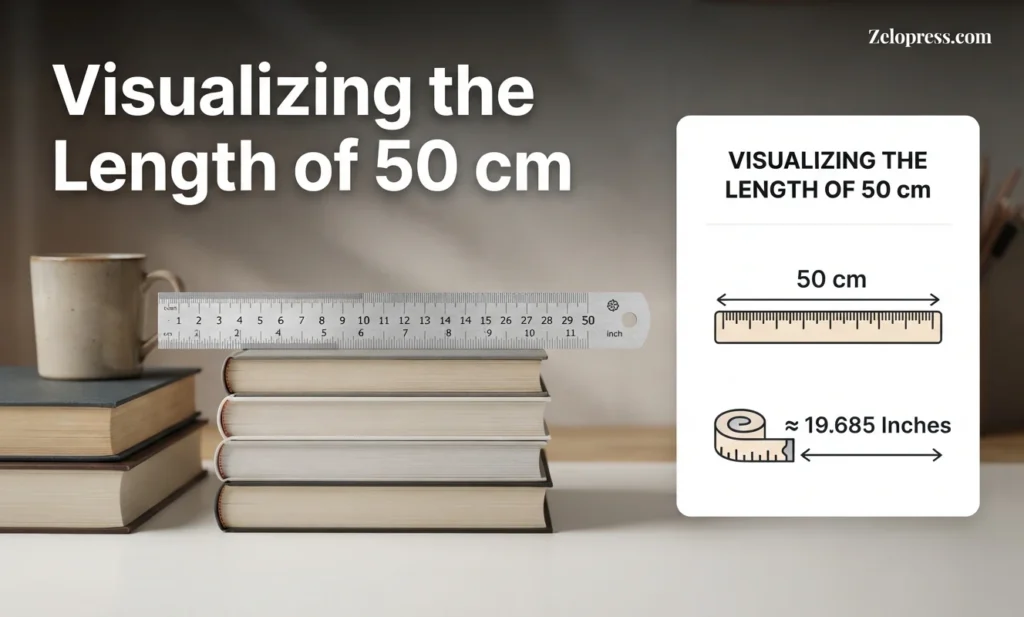
Picture half of a meter stick. That’s your most direct view of 50 cm.
On an inch tape, find the mark just below 20 inches. The 19 11/16-inch line is a very close match.
50 cm to Inches for a Baby
A baby length of 50 cm is about 19.7 inches. This is close to the WHO median length at birth: 49.9 cm for boys and 49.1 cm for girls.
A median is a middle reference point, not a target. Healthy babies come in different lengths. A pediatrician can explain a child’s growth over time.
Baby clothing labeled “50” often refers to a size system based on height. Fit differs by brand, so check its height and weight chart.
50 cm in Inches for the Waist
A 50 cm waist measurement is about 19.7 inches around. It is a circumference, not the width seen from the front.
This number may appear on children’s clothing or a garment size chart. Check whether the chart lists body measurements or the garment itself. Stretch fabric and elastic can also change the fit.
For sewing or ordering, keep a flexible tape level and comfortably relaxed. Follow the brand’s instructions for where to measure.
Everyday Objects That Measure Around 50 cm

These comparisons help you picture the size. Product dimensions vary unless a standard size is stated.
| Reference | Approximate length | Compared with 50 cm |
| A4 long side + A4 short side | 50.7 cm (19.96 in) | 0.7 cm longer |
| US letter long side + short side | 49.5 cm (19.5 in) | 0.5 cm shorter |
| Three US bills end to end | 46.8 cm (18.42 in) | 3.2 cm shorter |
| Square cushion labeled 50 × 50 cm | 50 cm per side | Nominal match |
| Carpet tile labeled 50 × 50 cm | 50 cm per side | Nominal match |
| One and two-thirds 30 cm rulers | 50 cm of markings | Direct match |
- Paper: Place two sheets end to end, with one turned sideways. US letter paper comes especially close.
- Dollar bills: Each is about 6.14 inches long. Three leave a gap of about 1.27 inches.
- Cushions: A cover’s listed size may differ from the filled cushion’s width. A plump insert pulls the edges inward.
- Rulers: Mark 30 cm, move the ruler, then add another 20 cm.
Why Knowing This Conversion Is Important
Product listings and instructions don’t always use the unit you know. A quick conversion can help you:
- Check whether an item fits your space
- Compare furniture or screen sizes
- Follow craft and sewing patterns
- Read international clothing charts
- Order materials in the correct unit
Small rounding changes matter when parts must fit together. Calling 50 cm “20 inches” adds about 8 mm. That may be harmless for a rough comparison but a problem for a snug insert.
Comparing Metric and Imperial Measurement Systems
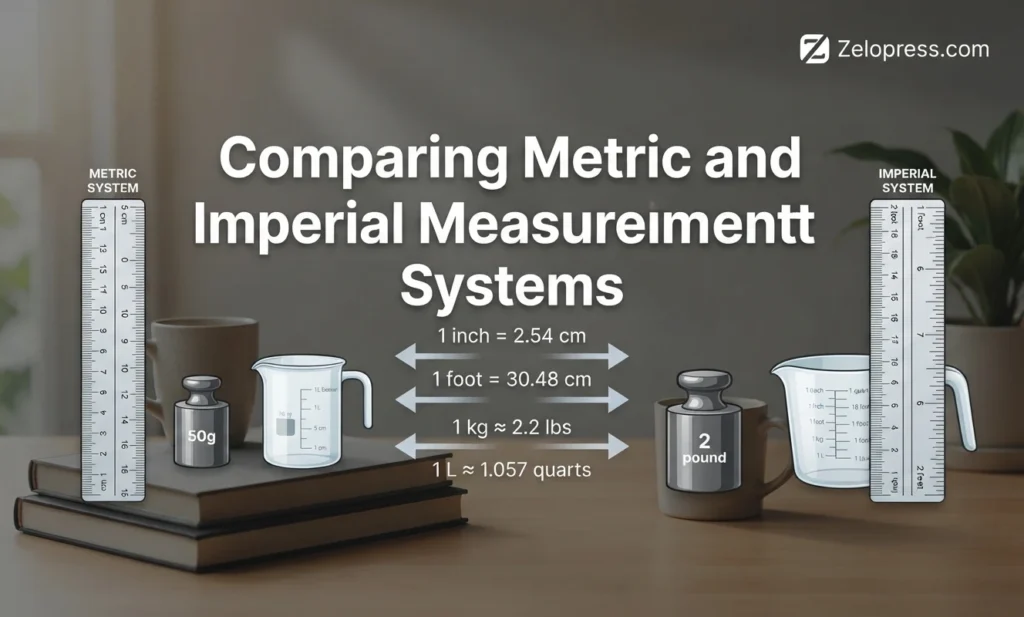
The metric system uses powers of 10. US customary units, often called imperial units in everyday searches, use different relationships. Inches and feet are shared with the British imperial system, though some other units differ.
| Feature | Metric | US customary / imperial length |
| Common units | mm, cm, m, km | in, ft, yd, mi |
| Small-unit link | 10 mm = 1 cm | 12 in = 1 ft |
| Larger-unit link | 100 cm = 1 m | 3 ft = 1 yd |
| Fraction style | Usually decimals | Often fractions on tools |
Metric conversions often involve moving a decimal point. Inch-based tools can be convenient when plans and materials already use feet and inches.
The best choice is usually the unit used by your plans. Switching back and forth can introduce rounding errors.
Converting 50 cm into Other Units
Here is half a meter expressed in other common length units.
| Unit | Value of 50 cm |
| Millimeters | 500 mm |
| Centimeters | 50 cm |
| Decimeters | 5 dm |
| Meters | 0.5 m |
| Kilometers | 0.0005 km |
| Inches | 19.685 in |
| Feet | 1.6404 ft |
| Yards | 0.5468 yd |
| Miles | About 0.000311 mi |
For millimeters, multiply by 10. For meters, divide by 100. To find yards, divide 50 by 91.44.
Estimating 50 cm Without Measuring Tools

You can make a rough estimate with items nearby:
- Use paper. Put the long side of a US letter sheet next to the short side of another. Add about 5 mm.
- Use a known hand span. If your span is 20 cm, mark two and a half spans.
- Use a known string. Fold a 1-meter cord exactly in half.
- Use floor tiles. Check the package or label first. One side of a 50 cm tile gives you the length.
Body size varies, so don’t assume your hand or forearm matches someone else’s. Estimates aren’t suitable for safety equipment, medical measurements or precision cuts.
Conversion Table for Nearby Measurements
Use this cm to inches chart when your measurement is a little above or below 50 cm. Values are rounded to two decimal places.
| Centimeters | Inches |
| 45 cm | 17.72 in |
| 46 cm | 18.11 in |
| 47 cm | 18.50 in |
| 48 cm | 18.90 in |
| 49 cm | 19.29 in |
| 50 cm | 19.69 in |
| 51 cm | 20.08 in |
| 52 cm | 20.47 in |
| 53 cm | 20.87 in |
| 54 cm | 21.26 in |
| 55 cm | 21.65 in |
Each extra centimeter adds about 0.39 inch.
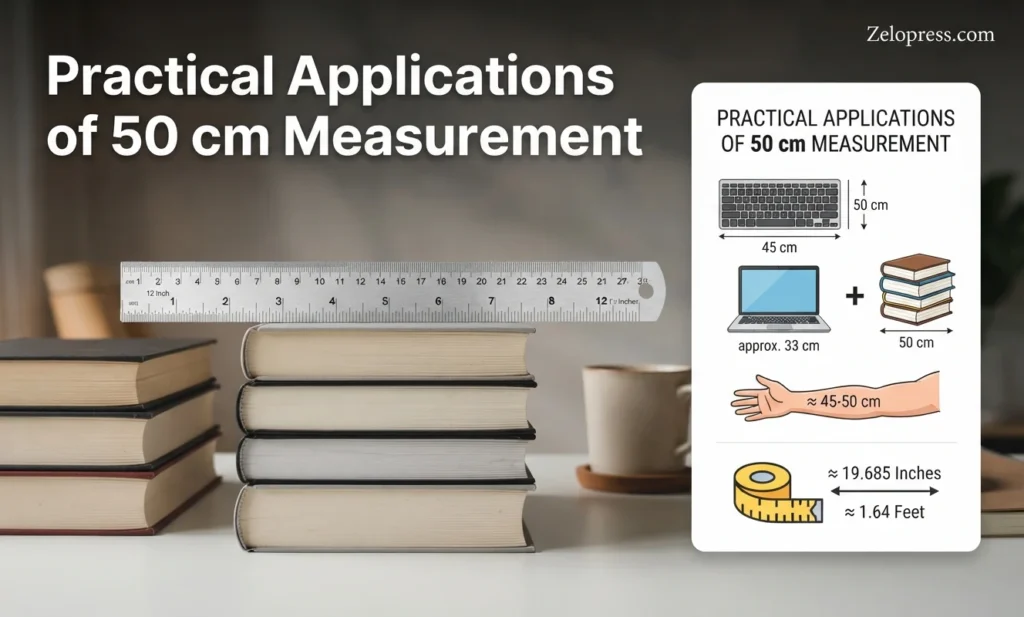
Practical Applications of 50 cm Measurement
Home and Furniture
A 50 cm cabinet needs more than 19.69 inches of space if doors, handles or installation gaps extend beyond it. Review the full dimensions and clearance instructions.
Sewing and Crafts
For 50 cm of fabric, check both length and bolt width. Buy extra if the project needs seam allowances, pattern matching or room for shrinkage.
Shipping and Travel
A box may have one side measuring 50 cm. Convert all three dimensions and check the carrier’s rules for measuring handles, wheels and bulges.
School and DIY
Write the unit beside every number. When possible, mark a part directly with a metric tape instead of converting several times. Round only at the final step.
Read More Measurement : How Big Is 6 Inches? Real-Life Size Comparisons & Examples
Frequently Asked Questions
What is 50 cm in inches?
50 cm is about 19.69 inches.
How many inches is 50 centimeters?
50 centimeters is just under 20 inches, or about 19.69 inches.
How long is 50 cm?
It’s half a meter, or about 19.69 inches.
Is 50 cm equal to 20 inches?
No, 20 inches is 50.8 cm, so it’s 8 mm longer.
What is 50 cm in feet?
50 cm is about 1.64 feet.
Conclusion
50 cm is about 19.69 inches, or 19 11/16 inches to the nearest sixteenth. It’s also half a meter and about 1.64 feet.
For a quick picture, put the long and short sides of US letter paper end to end. You’ll be just 5 mm short.
Use 20 inches only as a loose estimate. For clothing, furniture, screens or DIY work, check what the measurement describes. Then use the exact formula and measure carefully.