
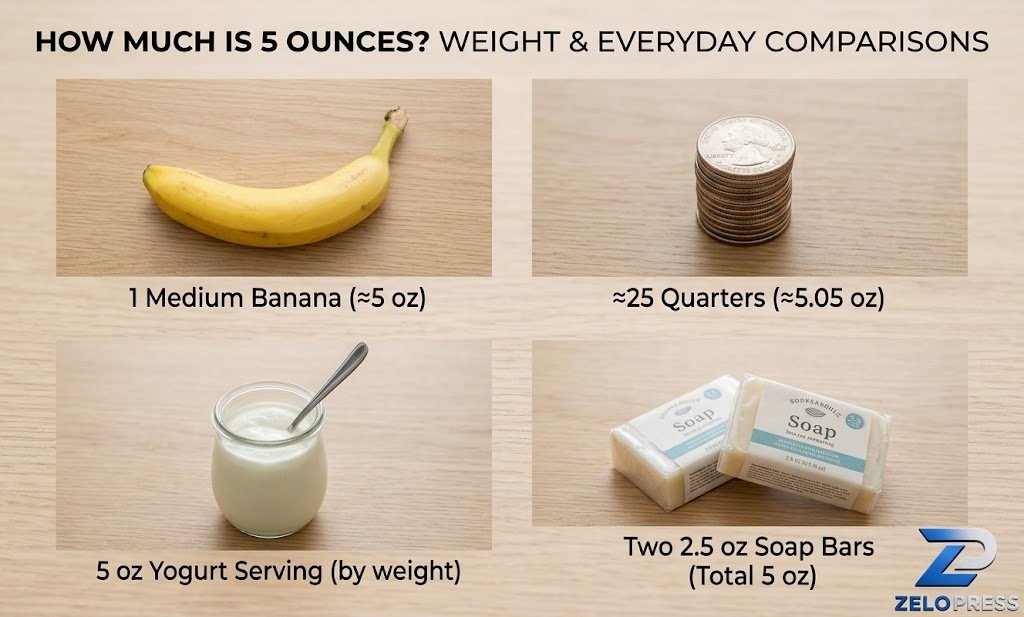

Five ounces is a small weight, but it is hard to picture without something to hold. In short, 5 ounces equals 141.75 grams, or 0.3125 pounds. That is about the weight of a baseball, a small apple, or a D-cell battery.
This guide shows what 5 ounces feels like, how to convert it into other units, and which familiar objects come close. We also cover a few much heavier comparisons for perspective.
Quick Answer: 5 Ounces in Other Units
| Unit | 5 oz equals |
| Grams | 141.75 g |
| Kilograms | 0.1417 kg |
| Pounds | 0.3125 lb (5/16 of a pound) |
| US tablespoons (fluid ounces) | 10 tbsp |
| US cups (fluid ounces) | 0.625 cup |
| Milliliters (US fluid ounces) | about 148 mL |
One thing to keep straight: the ounce (oz) measures weight, while the fluid ounce (fl oz) measures volume. They match only for water-like liquids, and even then only roughly.
1. Small Bottle of Glue
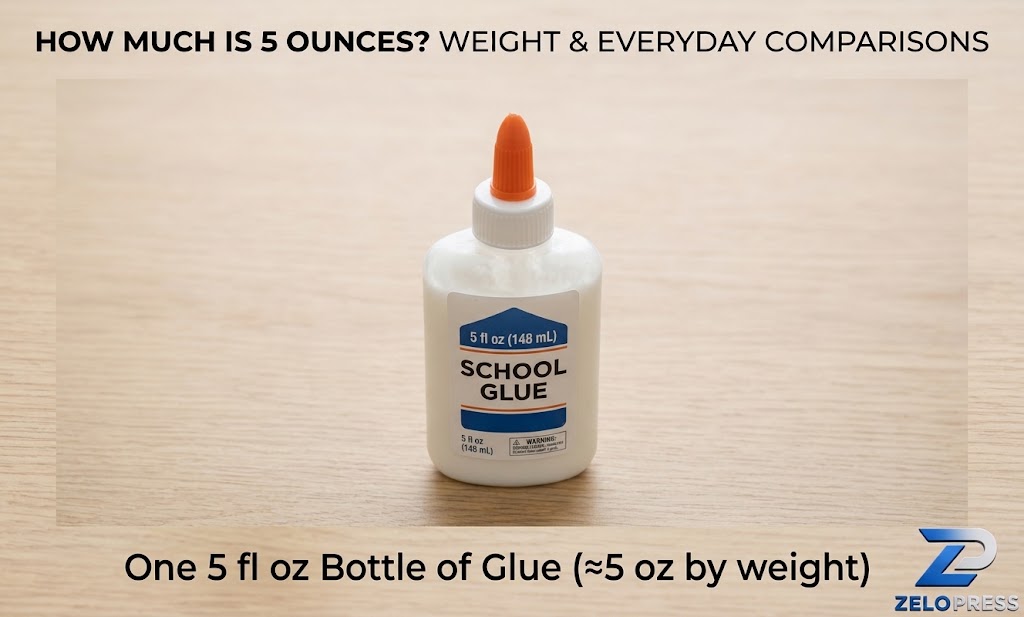
A small bottle of white school glue is a handy example. Many bottles hold 4 to 5 ounces of glue, and the plastic adds a little extra. Pick one up and you feel the weight of 5 ounces in one hand.
2. A Checkbook
A standard checkbook with a cover and a few dozen checks usually weighs somewhere between 4 and 6 ounces. The exact number depends on the page count and the cover material, so treat it as a ballpark.
3. A Half-Deck of Cards
Here is a common claim that needs a correction. A full 52-card deck weighs roughly 3.3 ounces, so a half-deck is only about 1.7 ounces. To reach 5 ounces, you need about three half-decks, or one and a half full decks.
Read More Measurement : How Much Is 5 Ounces
4. A Baseball
Official baseballs must weigh between 5 and 5.25 ounces, which makes this the most accurate comparison on the list. If you have thrown a baseball, you already know how 5 ounces feels.
5 Ounces to Liters
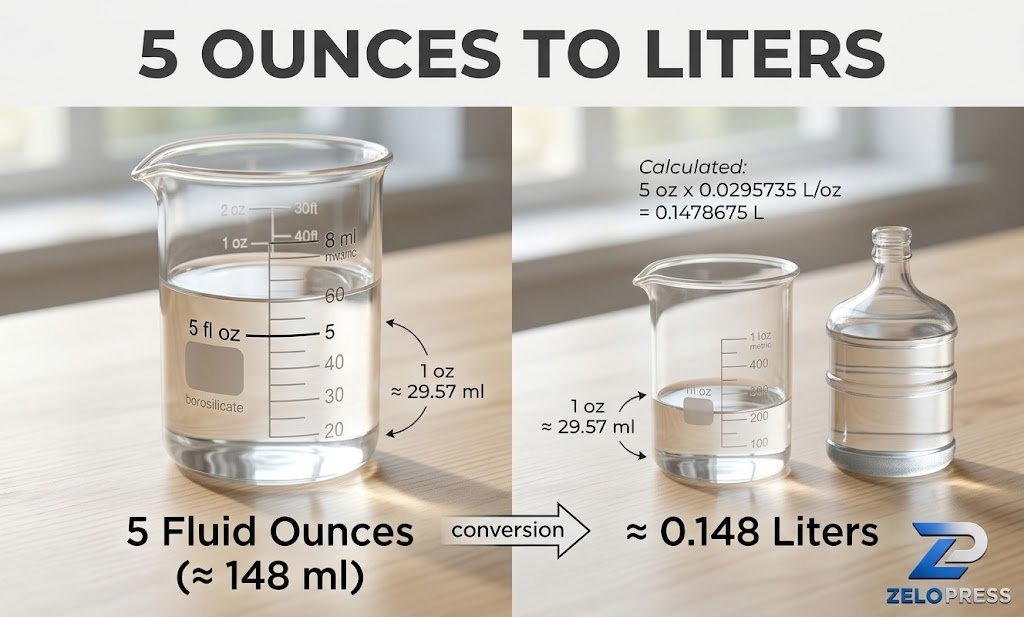
Weight and volume are different, so the answer depends on the substance. For water, 5 ounces by weight is about 142 grams, or roughly 0.142 liters. For 5 US fluid ounces, the answer is about 0.148 liters.
5 Ounces to Pounds
Divide by 16. Five ounces is 0.3125 pounds, a little less than one third of a pound.
5.5 Ounces to Grams
Multiply by 28.35. Five and a half ounces is about 155.9 grams. That is the weight range of many hockey pucks and billiard balls.
5 Ounces to Tablespoons
For liquids, 1 US fluid ounce equals 2 tablespoons, so 5 fluid ounces is 10 tablespoons. For dry goods, it depends on density, so weigh them on a scale.
5. A Medium-Sized Apple
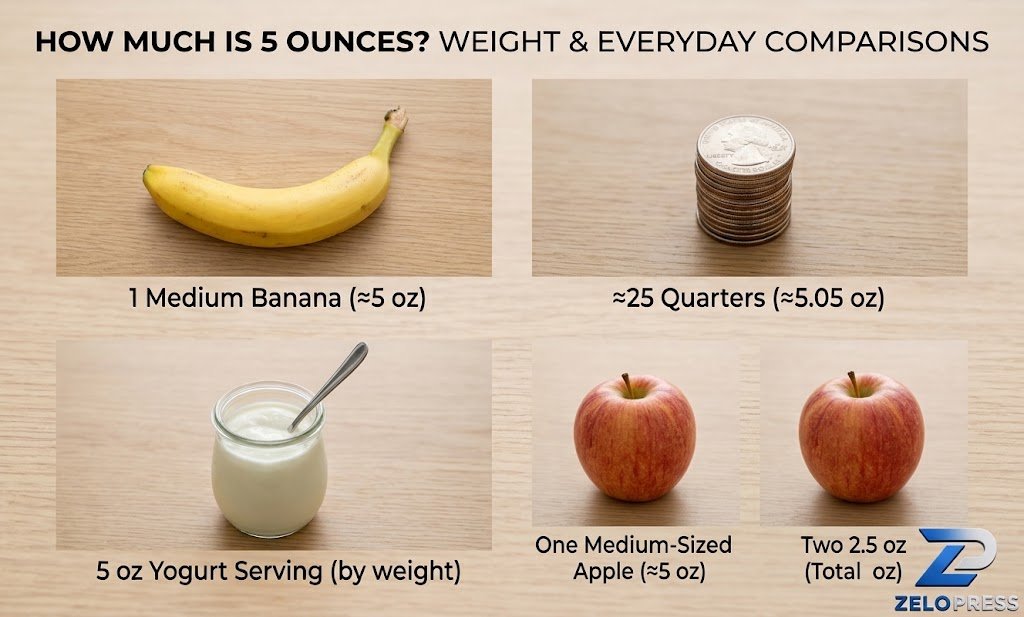
A small to medium apple weighs about 5 ounces. Larger “medium” apples at the grocery store often reach 6 ounces or more, so size matters. A small orange or a large lemon gives a similar feel.
6. One ‘D’ Size Battery
A standard alkaline D-cell weighs about 4.8 ounces. It is one of the closest household matches to 5 ounces, and it is easy to find in a kitchen drawer.
7. Double Pack of C Size Batteries
A single C-cell weighs about 2.4 ounces. A two-pack therefore lands near 4.8 ounces, which is nearly identical to one D-cell.
8. A Billiard Ball
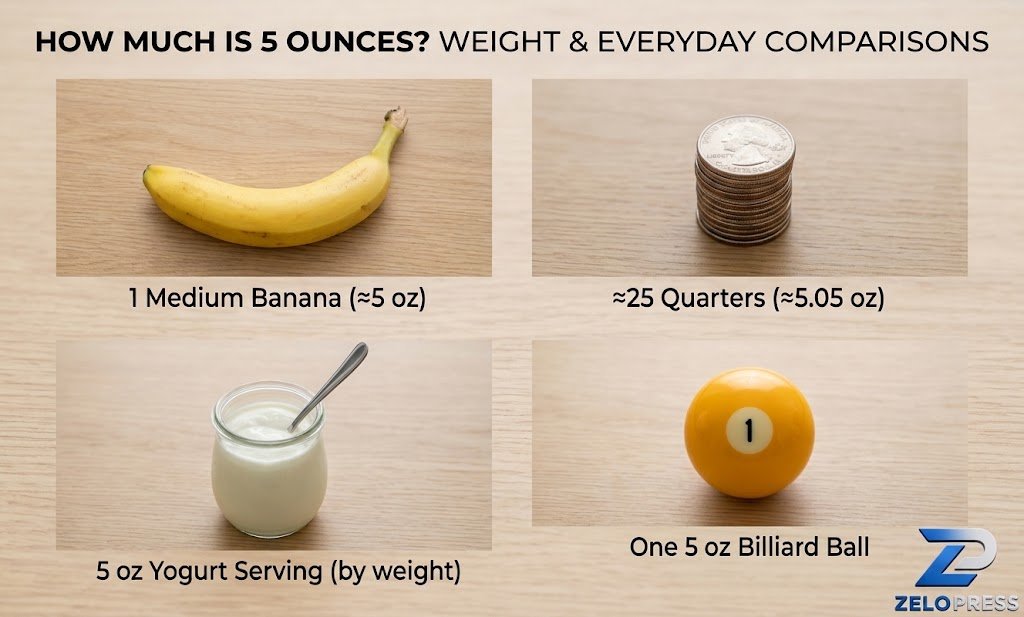
Regulation pool balls weigh between 5.5 and 6 ounces, so a billiard ball is slightly heavier than 5 ounces. It is still a good mental reference for something dense and compact.
9. An Ice Hockey Puck
A hockey puck also weighs 5.5 to 6 ounces. It is small and hard, which makes it feel heavier than a 5-ounce apple of the same size would.
10. Tennis Balls
A tennis ball weighs about 2 ounces (56 to 59 grams). Two and a half balls come to about 5 ounces. Three balls in a can add up to a little over 6 ounces.
11. Smartphones
Most smartphones weigh between 5 and 7 ounces, or about 140 to 200 grams. Check your own phone’s spec sheet and you will probably find it sits right around 5 ounces.
5 Ounces to Grams
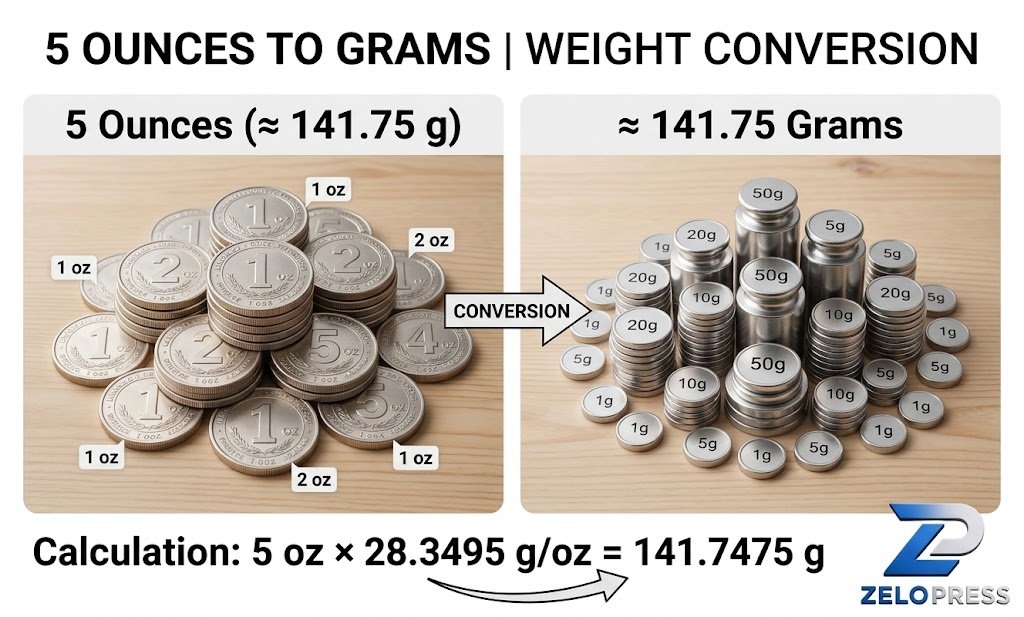
Multiply ounces by 28.3495. Five ounces equals 141.75 grams. For quick cooking estimates, round it to 142 grams.
5 Ounces to Kilograms
Divide the grams by 1,000. Five ounces is 0.1417 kilograms, a bit more than one tenth of a kilo.
5 Ounces to Milliliters
For water, 5 ounces by weight is about 142 mL. For 5 US fluid ounces, use 29.57 mL per fl oz, which gives about 148 mL. Imperial (UK) fluid ounces are slightly smaller, at about 142 mL for five.
Why Knowing 5 Ounces Matters
A small weight shows up in more places than you might expect:
- Cooking and baking: recipes often list ingredients by weight, and a few grams can change the texture of bread or cake.
- Wine service: a standard restaurant pour is commonly 5 fluid ounces.
- Shipping: postage is priced in weight tiers, so a parcel at 5 ounces can cost less than one at 6.
- Portion control: nutrition labels and meal plans frequently list portions in ounces and grams.
- Travel and gear: hikers and photographers count ounces because small weights add up over a long day.
How to Measure 5 Ounces Accurately
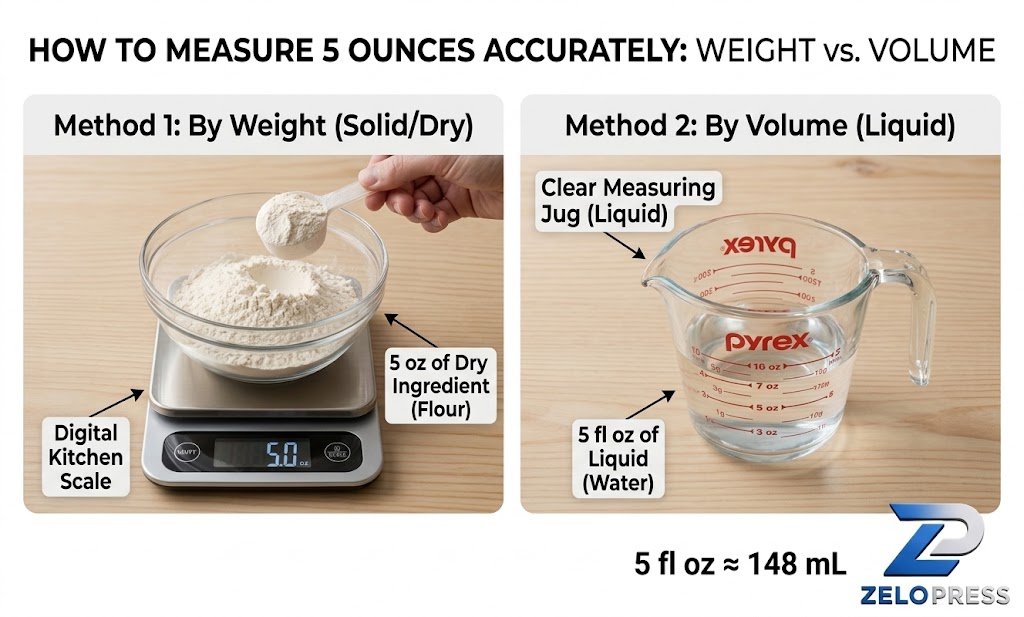
- Place a bowl or container on a digital kitchen scale.
- Press the tare button so the display reads zero.
- Switch the unit to ounces, or to grams if you want 141.75 g.
- Add your item slowly until the display reads 5 oz.
- For liquids by volume, use a measuring cup marked in fluid ounces instead.
Flour deserves extra care. It packs down in a cup, so a scale gives far better results than scooping.
5 Ounces at a Glance: Comparison Table
| Item | Typical weight | Close to 5 oz? |
| Baseball | 5 to 5.25 oz | Yes |
| D-cell battery | about 4.8 oz | Yes |
| Two C-cells | about 4.8 oz | Yes |
| Small apple | about 5 oz | Yes |
| Hockey puck | 5.5 to 6 oz | Slightly heavier |
| Billiard ball | 5.5 to 6 oz | Slightly heavier |
| Tennis ball | about 2 oz | Need 2.5 balls |
| Half-deck of cards | about 1.7 oz | Need 3 half-decks |
Going Bigger: Heavy Things for Perspective
List of Things That Weigh 100 Tons
- Blue whale: an adult often weighs 100 to 150 tons.
- Space Shuttle orbiter: the empty orbiter weighed roughly 80 to 90 tons.
- Large diesel-electric locomotive: many weigh between 100 and 200 tons.
- Large industrial transformer: the biggest power-grid units can reach or pass this mark.
List of the 13 Heaviest Materials on Earth
Density measures how much mass fits into a given volume. These are the densest naturally relevant elements, with approximate figures in grams per cubic centimeter.
| Rank | Material | Density (g/cm³) |
| 1 | Osmium | 22.59 |
| 2 | Iridium | 22.56 |
| 3 | Platinum | 21.45 |
| 4 | Rhenium | 21.02 |
| 5 | Neptunium | 20.45 |
| 6 | Plutonium | 19.84 |
| 7 | Gold | 19.32 |
| 8 | Tungsten | 19.25 |
| 9 | Uranium | 19.05 |
| 10 | Tantalum | 16.65 |
| 11 | Mercury | 13.53 |
| 12 | Rhodium | 12.41 |
| 13 | Lead | 11.34 |
Here is a striking way to see density at work. Five ounces of osmium takes up only about 6.3 cubic centimeters, roughly the size of a large gumball. Five ounces of an apple, by contrast, fills a whole hand.
List of Things That Weigh One Ton
- A full-grown bull, often 1,800 to 2,200 pounds
- A compact car
- A large male walrus
- A pallet stacked with about 450 standard bricks
- A large bison bull at the top of its size range
How Much Do Cows and Bulls Weigh? A Comprehensive Guide
Weight varies by breed, age, and purpose. These are typical adult ranges.
| Animal | Typical weight |
| Beef cow | 1,000 to 1,400 lb |
| Dairy cow (Holstein) | about 1,500 lb |
| Bull | 1,800 to 2,400 lb |
| Calf at birth | 60 to 100 lb |
6 Household Items That Weigh About 10 Pounds
- A 10-pound bag of potatoes
- A 10-pound dumbbell
- A 10-pound bowling ball
- A healthy adult house cat (many fall near 10 pounds)
- About 1.2 gallons of water
- A small watermelon
Ten pounds equals 160 ounces, so that is 32 times the weight of 5 ounces.
Read More Measurement : How Much Is 5 Ounces
FAQs
How many grams is 5 ounces?
Five ounces is 141.75 grams, or about 142 grams when rounded.
Is 5 ounces the same as half a pound?
No. A pound has 16 ounces, so half a pound is 8 ounces. Five ounces is 0.3125 pounds.
How many tablespoons are in 5 ounces?
For liquids, 5 fluid ounces equal 10 US tablespoons. Dry ingredients vary, so weigh them.
What common object weighs 5 ounces?
A baseball is the best match at 5 to 5.25 ounces. A D-cell battery and a small apple also come close.
Is 5 ounces the same as 5 fluid ounces?
No. Ounces measure weight and fluid ounces measure volume. They are only close for water-like liquids.
Conclusion
Five ounces is light, compact, and easy to picture once you link it to something familiar. A baseball, a D-cell battery, and a small apple all land very close, while hockey pucks, billiard balls, and many phones run a little heavier.
For conversions, remember three numbers: 141.75 grams, 0.3125 pounds, and 10 tablespoons of liquid. When accuracy matters, as in baking or shipping, use a kitchen scale and check whether the label means weight or fluid volume.